
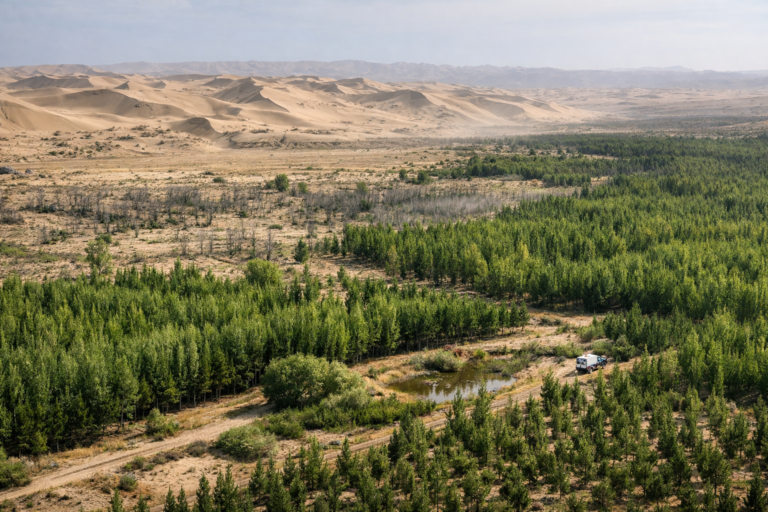
China’s massive tree-planting programmes — sometimes summarized as “a billion trees” efforts — are widely credited with slowing desert expansion, reducing dust storms and sequestering carbon. Yet the same campaigns draw sharp criticism from ecologists who argue that well-intentioned mass planting can degrade local ecosystems, drain water resources and replace biodiverse grasslands with fragile monocultures.
What the campaigns have achieved
Over the past few decades China has launched large initiatives — like the Three-North Shelterbelt Program (the so‑called “Great Green Wall”), Grain for Green and regional sand-control projects — to arrest desertification across northern and northwestern provinces. Reported outcomes include:
- Reduced desert advance in targeted zones.
- Fewer severe dust storms affecting Beijing and other cities.
- Increased above-ground biomass and measurable carbon uptake.
- Improved local livelihoods in some planting and maintenance jobs.
These achievements are real and politically visible, making tree-planting an appealing climate and land-restoration narrative: plant trees, stop deserts, capture carbon.
Why some experts worry
Despite headline successes, many scientists and local stakeholders warn that the campaign’s methods can do more harm than good in certain landscapes. Key concerns include:
- Monoculture planting: Fast-growing, non-native species such as poplar or certain pines are often favoured because they establish quickly. Large stands of a single species reduce biodiversity and are more susceptible to pests, disease and die-off.
- Water stress and lowered groundwater: Trees generally consume more water than native grasses and shrubs. In arid and semi-arid regions, extensive tree belts can lower water tables, dry out soils and harm downstream water availability.
- Soil salinization and compaction: Poorly suited species or planting densities can lead to saline layers and compacted soils that hinder long-term vegetation recovery.
- Altered ecosystem function: Replacing diverse steppe and grassland systems with forested monocultures can diminish habitat for native wildlife and change fire regimes and nutrient cycling.
- High mortality and maintenance costs: Many planted saplings die without sustained irrigation or care. Large-scale failure undermines ecological goals and wastes resources.
- Misleading metrics: Focusing on tree count or canopy area can obscure ecological quality. A hectare of monoculture plantation is not equivalent to a restored native ecosystem.
Examples from the field
In parts of Inner Mongolia and Gansu, researchers have documented poplar belts that initially stabilized soils but later contributed to groundwater decline and local plant-community shifts. Other studies show that converting steppe to tree plantations reduced forage for pastoralists and altered insect and bird assemblages. Conversely, carefully designed native shrub and mixed-species plantings in some pilot areas have shown greater resilience and biodiversity benefits.
What better restoration looks like
Experts who critique the mass-planting approach aren’t necessarily anti-afforestation; they advocate smarter, ecosystem-aware restoration. Recommended practices include:
- Prioritize native species and mixes tailored to local climate and soil.
- Use mixed planting densities rather than uniform grids.
- Favor shrubs and grasses where those vegetation types are the historical norm.
- Monitor groundwater, soil chemistry and biodiversity, not just tree survival.
- Involve local communities and herders in planning and benefit-sharing.
- Apply adaptive management: pilot, measure, adjust before large-scale rollout.
Balancing scale and ecology
Large-scale action is vital to combat land degradation, climate change and air pollution. But scale without ecological nuance can produce brittle outcomes. The challenge for China — and any country pursuing afforestation at scale — is to combine ambition with local ecological knowledge and long-term monitoring.
Planting a billion trees can slow the desert. But unless those trees are the right trees in the right places, and unless restoration targets the full web of soil, water, flora and fauna, the short-term gains risk becoming long-term liabilities. Thoughtful, science-driven restoration that privileges native ecosystems, water balance and community needs offers a more sustainable path forward.