
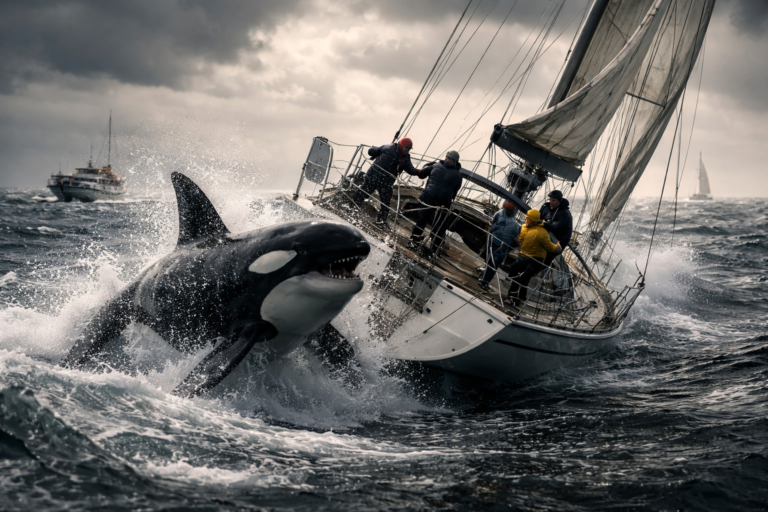
Orcas — charismatic, intelligent and long-celebrated as “killer whales” — are suddenly in the headlines for a very different reason. In recent years, a rising number of incidents in European and Atlantic waters have seen orcas damaging and disabling sailing boats, leaving crews stranded and marine authorities grappling with a fraught clash between public safety, property damage and species protection.
What’s happening out at sea?
Reports describe orcas repeatedly approaching sailboats, biting or ramming rudders, propellers and hulls. In many cases the animals don’t seem intent on harming people; instead, they appear to target the parts of the vessel that make them stop or steer. The damage can be severe: broken rudders, lost steering control, and long, expensive repairs that place sailors at risk when they are left adrift.
These events are not isolated curiosities. Where they appear, incidents can escalate quickly because the behavior spreads across pods and regions — a process researchers call cultural transmission. Once a few animals learn that a boat provides a novel stimulus, the behavior can propagate and accelerate.
Why might orcas be doing this?
No single explanation is universally accepted, but scientists and observers point to several plausible factors:
- Curiosity and play: Orcas are highly social and playful. Interacting with moving objects can be stimulating and rewarding.
- Learning and social spread: A learned behavior in a few individuals can be imitated across a pod and then across neighboring groups.
- Sensory attraction: Rudders and keels produce sounds and vibrations; orcas may investigate or target them intentionally.
- Environmental pressures: Changes in prey availability or human activity could be altering normal behaviors and increasing encounters.
Importantly, orcas are protected in most of the world. Their conservation status and cultural reputation complicate any direct or lethal response.
The dilemma for authorities
Marine authorities must balance three competing priorities:
- Safety: Protect sailors and professional mariners from potential harm, and ensure rapid rescue and assistance when vessels are disabled.
- Property and economic impacts: Yachting, shipping, and related tourism can suffer from repeated damage and heightened fear among boaters.
- Conservation: Orcas are legally protected under various national and international statutes; culling or aggressive deterrence is usually prohibited and ethically fraught.
This makes the policy response politically charged. Some stakeholders call for stronger protection and research funding; others press for tougher measures to protect mariners and livelihoods. In practice, authorities are choosing intermediate routes: advisories, monitoring, and non-lethal mitigation.
What are marine authorities doing?
Responses vary by region but commonly include:
- Advisories and guidance for sailors: Keep distance from pods, avoid towing or sudden manoeuvres, and report interactions immediately.
- Increased monitoring: Patrols, drones and acoustic monitoring to track the presence of orcas and issue warnings.
- Research funding: Studies into why the behavior started and how it spreads, including tagging and behavioural analysis.
- Trialling deterrents: Non-lethal measures such as acoustic devices are being explored, though they carry risks of disturbing whales or affecting other species.
- Legal and policy reviews: Considering exclusion zones, speed limits, or temporary restrictions in hotspots.
Authorities are generally reluctant to endorse measures that harm orcas, but they are under pressure from mariners and insurers to act decisively.
Practical advice for sailors
If you cruise in an area with reported orca interactions, consider these precautions:
- Stay informed: Check local maritime advisories before departure.
- Keep distance: Give groups of orcas as wide a berth as possible.
- Reduce noise and speed: Move slowly and avoid sudden wakes that might attract attention.
- Report incidents: Notify coastguard or marine authorities so they can respond and monitor patterns.
- Prepare for loss of steering: Carry emergency communication gear and know local towing or rescue procedures.
A way forward
The spike in orca–boat interactions shows how human activity and wildlife behavior can collide in unexpected ways. The best path forward combines rigorous science, clear rules for mariners, better monitoring, and open communication between conservationists and coastal communities. That won’t be simple: protecting a species while protecting people and livelihoods will force difficult trade-offs. But with thoughtful policy, rapid reporting systems and investment in non-lethal mitigation, it’s possible to reduce risks without abandoning the whales that once symbolized the wild, open sea.