
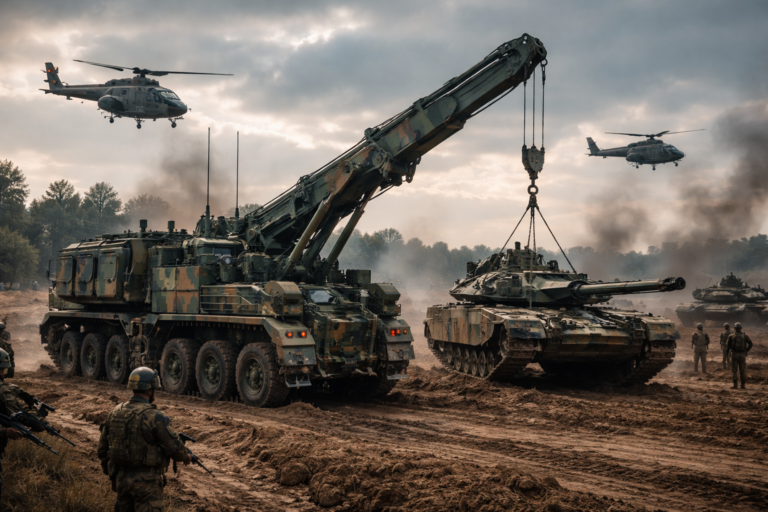
France has quietly begun to stack the logistical deck in favor of its armored formations: France orders an army of heavy recovery giants to back Europe’s most ambitious land armament programme: SCORPION. Behind the headlines about new Griffon and Jaguar combat vehicles, this procurement addresses a less glamorous but indispensable capability — recovering, repairing and returning damaged vehicles to the fight.
Why heavy recovery vehicles matter
Combat vehicles are only as useful as the logistics that sustain them. Heavy recovery vehicles (HRVs) are the tow trucks of the battlefield: high-power winches, heavy-duty cranes, armored protection and specialized tooling let them extract, stabilize and repair knocked-out tanks or armored personnel carriers under threat conditions. In modern high-intensity operations — where mobility, networking and rapid repair are mission-critical — recovery capability determines operational tempo and attrition resilience.
For a programme like SCORPION, which seeks to field a tightly-integrated combined-arms force of new infantry mobility vehicles, reconnaissance systems and digital command networks, recovery vehicles are more than support assets. They are force multipliers that preserve combat power, reduce materiel losses and shorten cycles for maintenance and redeployment.
How these giants support SCORPION
SCORPION aims to replace and modernize large swaths of France’s ground forces with a common tactical architecture: the Griffon multi-role armoured vehicle, the Jaguar reconnaissance platform, modernized Leclerc tanks, and a digital combat information system linking them all. Heavy recovery giants are designed to work specifically with this ecosystem.
Key functions HRVs deliver to SCORPION units include:
- Rapid battlefield extraction of damaged or immobilized vehicles.
- In-theatre stabilization and basic repair to enable vehicle return to unit.
- Evacuation of ammunition and sensitive equipment from wrecks.
- On-site maintenance staging, using cranes and power-generation capabilities.
- Protection for recovery crews while operating close to the front line.
Because SCORPION vehicles emphasize modularity and electronics-heavy subsystems, recovery crews need specialized diagnostic tools, spares handling systems and electromagnetic safety measures — all built into modern HRVs.
Design features of modern recovery giants
The latest generation of heavy recovery vehicles combines brute strength with battlefield smarts:
- High-capacity cranes and winches capable of lifting and towing main battle tanks and heavy APCs.
- Armored cabs and remote-operated equipment to keep crews safe during recovery operations.
- Integrated power supplies and workshops for field repair and diagnostics.
- Hydraulic platforms and modular equipment bays for flexible mission loads.
- Communications suites compatible with SCORPION’s digital networks to coordinate recovery tasks securely.
These platforms are engineered to operate alongside mechanized formations at operational pace, and to survive the threats — from mines to indirect fire — they may encounter while retrieving valuable assets.
Strategic and operational benefits
Investing in a fleet of heavy recovery giants yields multiple advantages:
- Lower attrition: Fewer vehicles declared total losses means more combat power retained.
- Faster turnaround: Speedier repairs get formations back to combat faster.
- Cost savings: Repairing and returning vehicles is often cheaper than full replacement.
- Morale boost: Crews have confidence that damaged vehicles won’t be abandoned.
- Interoperability: Standardized recovery platforms simplify allied logistics and joint operations.
At a broader level, these recovery assets reinforce the SCORPION concept by ensuring that the program’s high-tech vehicles remain sustainable in prolonged operations, enhancing France’s and Europe’s deterrence credibility.
What to watch next
As France brings these recovery giants into service, watch for:
- Integration trials with Griffon, Jaguar and upgraded Leclerc formations.
- Doctrine updates that embed recovery operations in maneuver plans.
- Export or NATO-compatible variants that could support allied interoperability.
- Advances in autonomous or remotely operated recovery tools to reduce crew risk.
Conclusion
France orders an army of heavy recovery giants to back Europe’s most ambitious land armament programme: SCORPION reflects a mature recognition that modern land warfare demands not only advanced fighting vehicles, but also robust systems to keep them fighting. These recovery platforms translate strategic investment into operational resilience — ensuring that the high-tech promise of SCORPION is matched by the practical logistics that sustain it.