
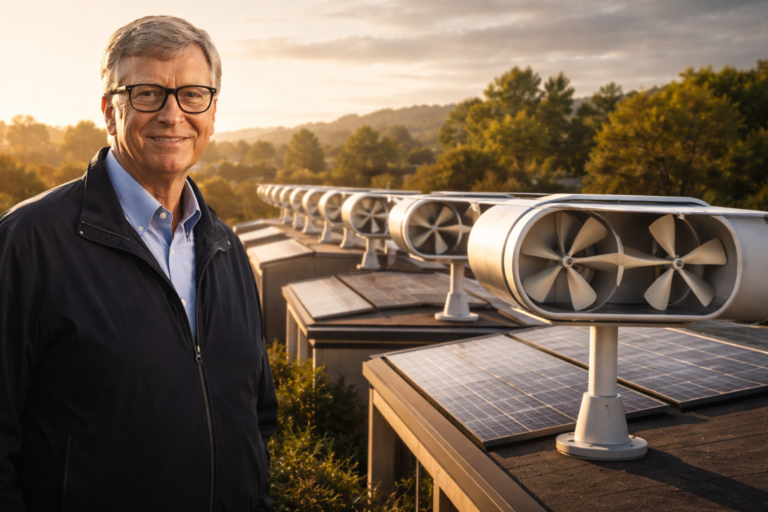
Technology headlines love bold claims. The idea that “Bill Gates is destroying your electric bills” with miniature wind turbines that “cost three times less and install almost anywhere in a year” is attention-grabbing — and it points to a real trend: deep-pocketed investors and climate-focused funds are backing innovations in small-scale wind power that could change how households and communities access electricity. Below I explain what these miniature turbines are, why Gates-backed investment matters, what the potential savings could look like, and what to watch for.
What are miniature wind turbines?
Miniature wind turbines are compact, often modular machines designed to generate electricity at a smaller scale than traditional utility-grade turbines. They can be:
- Horizontal-axis or vertical-axis designs
- Rooftop or pole-mounted
- Designed to work in lower wind speeds
- Easier to manufacture, transport, and install than large turbines
Their size and modularity make them suitable for distributed generation — supplying power directly to homes, farms, microgrids, or small businesses instead of large centralized plants.
Why Bill Gates (and others) are paying attention
Bill Gates, through philanthropic and investment channels focused on climate tech, has helped accelerate research and commercialization of low-carbon technologies. While Gates himself isn’t personally manufacturing turbines in his garage, funds and firms associated with him prioritize supporting scalable solutions that can decarbonize electricity affordably.
Why that matters:
- Deep capital helps startups iterate rapidly and scale manufacturing.
- Strategic funding attracts talent, partnerships, and regulatory attention.
- Backing from high-profile investors can speed pilot projects and public acceptance.
This ecosystem effect means promising small-scale wind concepts can move faster from prototype to market.
How miniature turbines could cut electric bills
Advocates claim miniature wind systems can be far cheaper to buy, install, and maintain than traditional wind or some local grid upgrades. If costs fall significantly, households could see lower bills through:
- On-site generation: offsetting grid electricity during windy periods
- Lower installation costs: faster deployment and simpler hardware reduce upfront expense
- Local resilience: powering critical loads during outages, reducing reliance on costly backup solutions
- Complementing solar: wind often generates at different times than solar, smoothing household generation profiles
The oft-repeated claim that these turbines “cost three times less and install almost anywhere in a year” should be read as an optimistic projection rather than a universal truth. In ideal scenarios — supportive regulations, good site winds, and streamlined supply chains — smaller turbines can be cheaper and faster to deploy. But results will vary by location, local permitting, and technology maturity.
Limitations and real-world hurdles
Don’t assume every homeowner will immediately slash their electric bill. Key challenges include:
- Intermittency: wind is variable; turbines alone rarely deliver 24/7 power without storage or grid connection.
- Site suitability: even small turbines need sufficient wind; urban canyons and heavily forested lots may underperform.
- Permitting and zoning: local rules, aesthetic concerns, and noise regulations can delay or block installs.
- Maintenance and reliability: smaller systems can have different maintenance needs and lifespans than large turbines.
- Economics: incentives, tariffs, and net-metering policies shape payback times.
These constraints mean adoption will be uneven, and the biggest savings will likely appear where wind resources, policy support, and community acceptance align.
What homeowners should watch and do now
If you’re curious about lowering your electric bill with small wind technology, consider these steps:
- Research local wind potential: simple online maps and anemometer data can indicate feasibility.
- Follow pilots and pilots’ results: look for local demonstration projects or university studies testing small turbines.
- Combine solutions: pairing small wind with solar and battery storage gives the best chance of reliable savings.
- Check incentives and permits: local rebates or tax credits can change the math, while zoning rules may limit options.
- Talk to neighbors and installers: community buy-in often smooths permitting and lowers installation costs through group buys.
Bottom line
The headline “Bill Gates is destroying your electric bills” captures the hope that well-funded innovation can drive down the cost of clean energy. While miniature wind turbines backed by major investors could indeed make local electricity cheaper and easier to install, the reality will depend on technology development, local wind resources, and policy frameworks. For forward-looking homeowners, keeping an eye on pilots, incentives, and hybrid systems is the smartest way to be ready when affordable, small-scale wind becomes a practical option in your area.