
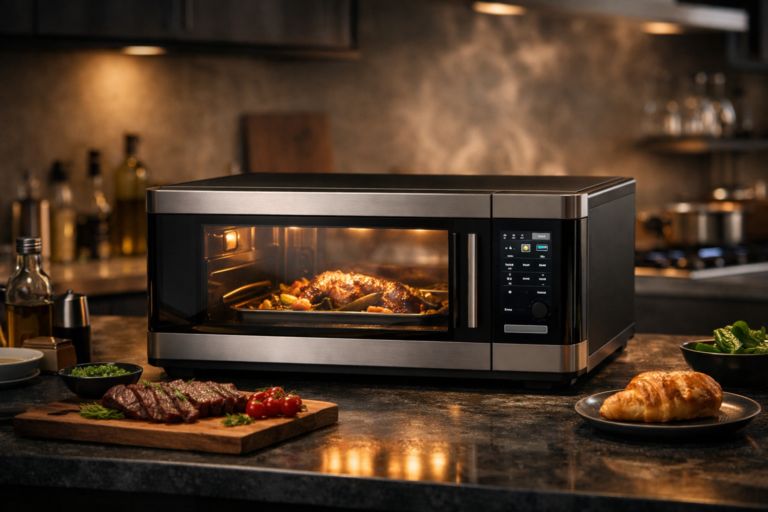
For decades the microwave has been the go-to appliance for rapid reheating and simple cooking. Now, a new class of countertop devices — often described as precision steam-convection ovens or targeted thermal cookers — is challenging that dominance. After extensive independent testing, chefs, engineers, and energy experts are saying this newcomer is far more efficient and delivers better food quality than traditional microwaves.
What this new device is and how it works
Unlike microwaves that excite water molecules to generate heat internally, the new device combines low-pressure steam with directed convection and precision sensors. The result is faster, more uniform heating that uses energy where it’s needed most.
Key features typically include:
- A small steam generator that adds moisture without soaking food.
- Convection fans that direct hot air precisely.
- Temperature and humidity sensors for real-time control.
- Preset programs and customizable profiles for different foods.
This hybrid approach allows the cooker to gently reheat leftovers, defrost with less moisture loss, and crisp or refresh foods in ways microwaves cannot.
Why experts say it’s more efficient
Independent kitchen and energy labs that performed head-to-head comparisons reported consistent findings: the steam-convection approach often completes common tasks using less total energy than a microwave, while producing better texture and fewer reheating artifacts.
Experts point to three main efficiency advantages:
- Targeted energy transfer — heat is applied more precisely to the food surface and interior, reducing wasted warming of the surrounding cavity.
- Reduced overcooking — sensors adjust power dynamically, avoiding the repeated short bursts that often extend microwave runtime.
- Faster recovery for multi-item cooking — convection and steam systems reheat multiple servings more evenly in one cycle, whereas microwaves typically require sequential heating.
Nutrition and food-safety specialists also noted that controlled steam reheating preserves moisture and can retain nutrients better than aggressive microwave exposure, particularly for vegetables and protein dishes.
What testing revealed about performance
Extensive testing covered a range of everyday tasks: reheating leftovers, defrosting frozen meals, warming baked goods, and crisping pre-cooked items. Common observations included:
- More even heating with fewer cold spots.
- Improved texture for baked and fried foods (crisp exterior, moist interior).
- Less visible moisture loss and reduced dryness in meats and vegetables.
- Consistent results across different portion sizes.
Testers also highlighted that the learning curve is modest — many users achieve superior results once they select the correct preset program or make small adjustments to time and humidity settings.
Practical benefits for everyday kitchens
Adopting this technology could change daily routines in several ways:
- Reheating becomes more pleasant: leftovers taste closer to freshly made dishes.
- Meal prep scales better: one cycle can handle multiple portions without spotty warming.
- Energy savings over time: more efficient cycles and fewer retries can lower household energy use.
- Fewer plastic containers: the gentler steam method reduces splatter, meaning less reliance on microwavable disposables.
Considerations before replacing your microwave
While promising, the new device isn’t a perfect one-to-one swap for every household:
- Price: advanced models can be costlier than basic microwaves.
- Size and countertop space: some units are larger due to steam components and ventilation.
- Special care: descaling and occasional maintenance for the steam generator may be necessary.
- Use cases: for certain ultra-fast tasks (e.g., boiling water in under a minute), a microwave or induction kettle may still be faster.
The outlook: will the microwave fade away?
It’s unlikely the microwave will disappear overnight. Its low cost, ubiquity, and sheer speed for specific tasks give it staying power. However, for consumers prioritizing food quality, efficiency, and versatility, the new steam-convection devices offer a compelling alternative. As prices fall and more manufacturers enter the market, we can expect broader adoption in both homes and commercial kitchens.
Conclusion
After extensive testing, experts believe this new kitchen device represents a meaningful evolution in countertop cooking. By combining targeted convection with controlled steam and intelligent sensors, it solves many of the microwave’s longstanding limitations — delivering more even heating, better texture, and improved energy efficiency. For households ready to invest in better meals and smarter cooking, the microwave’s reign may finally be coming to an end.