
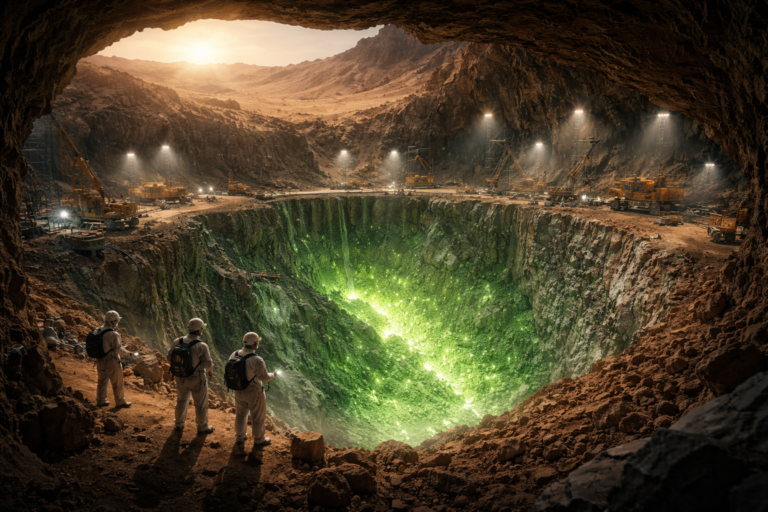
Imagine waking up to headlines announcing that a previously unknown, extraordinarily rich deposit of nuclear fuel sits beneath a patch of desert. A giant find under the desert could upend the global nuclear race — not by a single dramatic event, but by shifting the balance of supply, politics, technology and regulation around the world.
Below I outline what such a discovery would mean, who would be affected, and the short- and long-term consequences for energy, security, and diplomacy.
What might be found, and why it matters
The most consequential discoveries would be:
- Extremely high-grade uranium ore, enough to supply reactors for decades.
- Massive thorium deposits suitable for alternative fuel cycles.
- Concentrated rare-earth or critical minerals that enable enrichment and weaponization.
Why this matters: nuclear power and weapons both depend on relatively scarce feedstocks. Control over those raw materials influences which nations can scale civilian nuclear programs quickly and who can project influence by exporting fuel or technology.
Immediate economic and market effects
A sudden increase in accessible nuclear fuel would ripple through commodity markets and energy planning.
- Uranium spot prices could plunge if supply expectations rise.
- Mining and processing sectors would see investment booms—possibly dominated by the first companies or states granted access.
- Countries highly reliant on imported fuel would reconsider supplier agreements and contracts.
- Downstream industries (enrichment, fuel fabrication) might accelerate capacity expansion in response.
Such market shifts would change the incentives for both civilian energy deployment and military ambitions. Cheaper, more abundant fuel reduces the cost barrier to expanding nuclear power and, potentially, to building fissile material stocks if safeguards are weak.
Geopolitical realignment and proliferation risks
Control of a giant deposit would be a strategic asset. States with access could gain bargaining power, influence ally behavior, and rewrite regional energy dependencies.
Potential geopolitical consequences include:
- New alliances formed around access to or protection of the deposit.
- Competition, including diplomatic pressure or economic coercion, to secure favorable mining terms.
- Increased risk of illicit procurement networks if governance is weak.
Proliferation risks are real. Even if a deposit is used for peaceful power generation, the same supply chains, enrichment facilities, and technical expertise can be diverted or misused. Robust international safeguards and transparency would be critical to prevent a destabilizing arms race.
Technology shifts: fuel cycles and reactors
A major new resource could accelerate certain technological pathways:
- Thorium-rich finds might revive interest in thorium fuel cycles and molten-salt reactors, touted for proliferation resistance and waste advantages.
- Abundant uranium could favor conventional light-water reactors and make small modular reactors (SMRs) cheaper to operate.
- If rare-earth or enrichment-related materials are abundant, centrifuge technology and enrichment expansion could follow.
Policymakers and utilities would need to weigh immediate cost benefits against long-term strategic and environmental trade-offs when choosing technologies.
Environmental and social considerations
Mining in arid, fragile desert ecosystems raises concerns beyond geopolitics.
- Groundwater depletion, radioactive tailings, and dust can harm local communities and biodiversity.
- Displacement of indigenous or rural populations might spark social unrest.
- Regulatory frameworks, environmental impact assessments, and transparent benefit-sharing would be essential to minimize harm.
Without strong oversight, a rush to exploit a giant find under the desert could create chronic environmental damage and local conflict—fueling wider instability.
Governance and the role of international institutions
The International Atomic Energy Agency (IAEA) and global governance mechanisms would be central to managing the fallout—political and literal.
Key governance actions would include:
- Rapid safeguards and monitoring to ensure material is used peacefully.
- Frameworks for equitable resource sharing and benefit distribution.
- Legal mechanisms to prevent export of sensitive technologies to bad actors.
Successful management would require cooperation between producing states, consumers, and multilateral institutions to prevent the discovery from becoming a catalyst for conflict.
Conclusion: opportunity wrapped in risk
A giant find under the desert could upend the global nuclear race by changing who controls fuel, which technologies accelerate, and how states interact on security and energy. The discovery would present both opportunity and risk: cheaper fuel and faster decarbonization on one hand, and increased proliferation and environmental harm on the other.
How the world responds—through governance, technology choices, and diplomacy—will determine whether such a find becomes a force for global stability and clean energy, or a new front in geopolitical competition.