
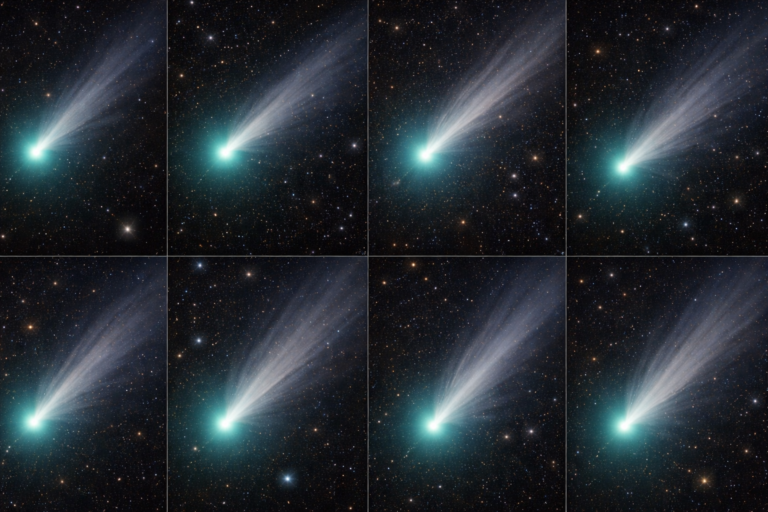
A new set of eight spacecraft images reveals the interstellar comet 3I ATLAS in astonishing clarity, offering scientists their clearest look yet at an object that originated beyond our solar system. Taken from multiple vantage points by a coordinated observing campaign, the images capture fine structural detail in the comet’s nucleus, coma, and dust tail—features that can tell us about the comet’s origin, composition, and history.
Why this set of images matters
Interstellar objects are rare visitors. Before 3I ATLAS, only a handful of such bodies had been identified, and most were observed only briefly and at great distance. The clarity of these eight images provides:
- Direct views of the nucleus shape and rotation.
- Clear evidence of localized jet activity and dust ejection.
- Improved constraints on the grain size and composition of the coma and tail.
- Comparative data to test models of interstellar formation and evolution.
Put simply, these images change the difference between a fuzzy speck and a well-resolved world we can study in detail.
What the images show
Although each image offers a different perspective, several consistent features emerge:
- Nucleus morphology: The images suggest an elongated or irregular nucleus rather than a simple sphere, with surface regions that appear brighter or darker—likely due to variations in composition or surface texture.
- Active jets: Narrow plumes of material are visible emerging from discrete spots on the nucleus. Jet activity provides clues about volatile reservoirs beneath the surface.
- Coma structure: The coma displays layered structures and arcs, hinting at episodic outgassing events and rotation-driven patterns.
- Dust tail properties: High-resolution imaging reveals variations in particle size distribution along the tail and subtle curvature consistent with solar radiation pressure acting on small grains.
Together, these features let researchers infer the physical and dynamical processes currently shaping 3I ATLAS.
How the images were taken
The images resulted from a coordinated effort using eight spacecraft positioned at distinct locations around the inner solar system. By combining observations taken from different angles and at slightly different times, scientists reconstructed a three-dimensional picture of the comet’s immediate environment.
Key techniques included:
- Multi-angle imaging to resolve shape and rotation.
- Time-series sequences to capture evolving jets and outbursts.
- Narrowband filters and broad-spectrum imaging to distinguish dust from gas.
- Image stacking and deconvolution to enhance faint structural detail.
This multi-platform approach minimizes the observational blind spots that can occur when relying on a single telescope.
Scientific implications
These images are not just pretty pictures—they have important scientific consequences:
- Composition and origin: Differences in color and spectral behavior across the coma may indicate varied volatile species and dust chemistry, offering clues about the comet’s birthplace in another stellar system.
- Formation and evolution: The nucleus shape and surface features help constrain formation scenarios—whether the object is a fragment of a larger body, the product of gentle accretion, or shaped by violent processes.
- Interstellar dust delivery: Understanding the particle size distribution helps model how interstellar comets deliver dust and complex molecules into planetary systems.
- Comparative planetology: Comparing 3I ATLAS with prior interstellar visitors (and with native solar-system comets) refines our knowledge of the diversity of small bodies across the galaxy.
What comes next
With these initial images now analyzed, teams are planning follow-up observations and deeper analyses:
- Spectroscopic follow-up to pin down molecular abundances and isotopic ratios.
- Detailed rotational modeling to map active regions on the nucleus.
- Continued monitoring to see how activity evolves as the comet moves away from the Sun.
- Laboratory experiments and computational models to interpret observed dust and ice behavior under interstellar formation conditions.
Upcoming observations from ground-based observatories and space telescopes will complement the spacecraft data, building a fuller picture of 3I ATLAS over months and years.
A window into other star systems
A new set of eight spacecraft images reveals the interstellar comet 3I ATLAS in astonishing clarity—and with it, a rare opportunity to study material forged around another star. Each detail captured brings astronomers closer to understanding how planetary systems form and evolve across the galaxy. As analyses continue, 3I ATLAS will remain a focal point for both specialists and the public, reminding us that even small visitors can change our view of the cosmos.