
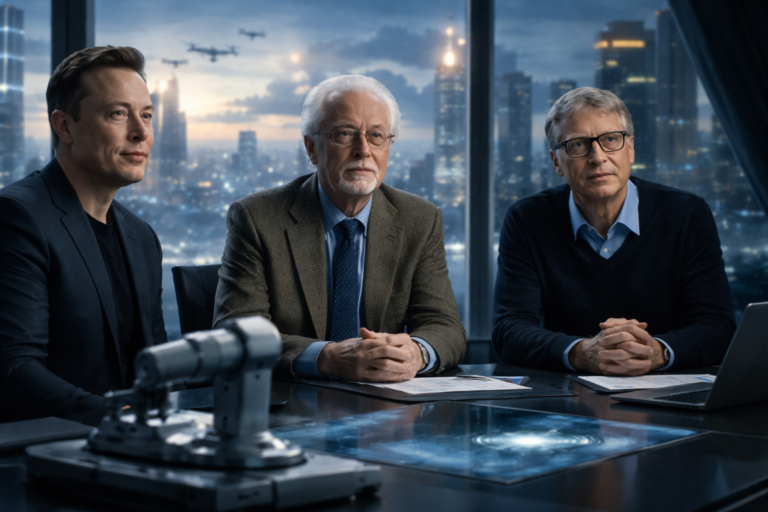
A growing chorus of thinkers is warning that rapid automation and advances in artificial intelligence will reshape the economy in ways that concentrate wealth and leisure in unexpected places. Recently, a Nobel laureate in physics joined voices similar to those of Elon Musk and Bill Gates, arguing that the future may increasingly reward machine owners while ordinary people face job displacement and a lot of unfulfilled free time.
This is not a prophecy so much as a diagnosis: when labor can be replaced by machines at scale, returns shift from wages to capital. The Nobel laureate’s perspective highlights both the technical inevitability of automation and the social choices that will determine whether gains are broadly shared.
Why experts are alarmed
Several factors drive this concern:
- Productivity gains from AI and robotics are accelerating: tasks once thought uniquely human are now automatable.
- Ownership matters: profits from automation accrue to those who own the machines, software, and data.
- Labor displacement is uneven: high-skill workers who build and maintain technology may prosper, while routine and even some cognitive jobs shrink.
- Social safety nets lag: policy often struggles to catch up with fast economic change, leaving displaced workers exposed.
Elon Musk has repeatedly argued that automation could make universal basic income (UBI) necessary. Bill Gates has suggested tax changes on automated labor (e.g., a “robot tax”) to finance retraining and social programs. The Nobel laureate’s agreement with these lines of thought underscores the cross-disciplinary anxiety: it’s not just technologists or politicians who see the risk but also leading scientists who understand the power of technology to transform production.
What the Nobel laureate’s warning implies
The core claim is stark: if ownership of productive machinery concentrates, the economy will reward those owners disproportionately. Ordinary people—facing job losses and insufficient alternative opportunities—may find themselves with plenty of time but little meaning or financial security. The laureate frames this as a moral and civic challenge rather than an unavoidable fate.
Key implications include:
- Growing inequality: capital owners capture most gains, widening wealth gaps.
- Social fragmentation: large swathes of the population may lack work that provides identity and purpose.
- Political pressure: disenfranchised workers may fuel populist movements or social unrest.
- Policy urgency: without intervention, market forces alone may not produce inclusive outcomes.
Possible policy responses
Experts mentioned by the laureate and public figures propose several solutions to prevent the dystopian outcome:
- Universal basic income (UBI): provide a baseline income so displaced workers can meet basic needs.
- Progressive taxation on automation profits: a tax on firms that replace human labor with machines to fund retraining and social programs.
- Investment in education and lifelong learning: reskill workers for new roles in an automated economy.
- Democratizing ownership: worker cooperatives, broad-based equity programs, or public ownership models to distribute returns from automation.
- Stronger social safety nets: healthcare, housing support, and mental health services to buffer transitions.
These options are not mutually exclusive and would require political will, careful design, and ongoing evaluation.
What individuals and communities can do now
While systemic policy matters most, there are pragmatic steps individuals and communities can take:
- Build adaptable skills focused on creativity, empathy, and complex problem-solving—areas where humans still excel.
- Advocate locally for education and retraining programs.
- Support models of shared ownership or community investment in technology.
- Engage in civic conversations about tax policy and social programs that address automation’s impacts.
Conclusion
The image painted by a Nobel laureate who agrees with voices like Musk and Gates is sobering: automation could create an economy that amplifies returns to machine owners while leaving many with surplus time but diminished purpose and security. Yet the future is not preordained. With deliberate policy choices, investment in people, and experiments in more inclusive ownership, societies can steer technological progress toward broad prosperity rather than concentrated wealth. A clear-eyed public debate and timely action will determine which path we take.