
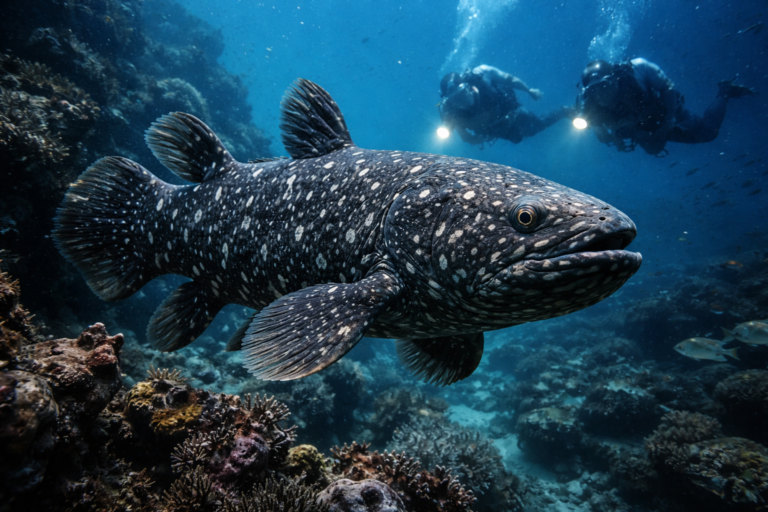
A breathtaking moment for marine science and conservation unfolded when a team of French divers recorded rare, close-range images of an emblematic species in Indonesian waters. Dubbed a true “living fossil,” this animal connects us directly to a distant past while reminding us how fragile deep-sea ecosystems remain.
Why this sighting matters
The species captured in the footage has long been considered a symbol of ancient oceanic lineages. Often described as a true “living fossil,” it represents an evolutionary branch that diverged hundreds of millions of years ago. To witness such an organism in its natural habitat is both a scientific breakthrough and a powerful reminder of biodiversity’s depth.
The imagery is notable not only for its rarity but also for who recorded it: French divers using advanced underwater cameras. Their presence in Indonesian waters and the quality of the footage allow researchers to study behavior, morphology, and habitat preferences with a clarity that was previously unavailable.
What the footage shows
Short, focused dives yielded images that highlight several striking features:
- Distinctive body shape and lobed fins that hint at ancient evolutionary roots.
- Slow, deliberate movements consistent with a deep-water lifestyle.
- Habitat context: steep rocky slopes, caves and overhangs at depth—areas known to shelter rare and sensitive species.
These observations align with long-standing hypotheses about the species’ ecology: it prefers stable, deep, low-light environments and displays low population density, which makes encounters uncommon.
Scientific and cultural significance
The discovery carries multiple layers of importance:
- Evolutionary insight: As a living representative of an ancient lineage, the species offers clues about vertebrate evolution and anatomical transitions.
- Behavioral data: High-quality footage enables preliminary analyses of locomotion, feeding posture, and potential interactions with other species.
- Public engagement: Iconic animals spark curiosity and support for marine protection; charismatic imagery helps translate complex science into public empathy.
Beyond the scientific community, this sighting reinforces cultural connections. In many coastal regions of Indonesia, traditional knowledge and local lore intersect with scientific discovery, creating opportunities for collaborative stewardship.
Conservation implications
While the footage is cause for celebration, it also underscores conservation urgency. Species with ancient lineages often have specific habitat needs and slow reproductive rates, making them especially vulnerable to human pressures. Key concerns include:
- Deep-sea fishing: Bycatch and habitat damage from trawling threaten rocky slopes and cave systems.
- Pollution and sedimentation: Coastal development can alter water quality and benthic environments.
- Climate change: Shifts in ocean temperature and chemistry can cascade through food webs, affecting even deep-dwelling species.
What can be done
Protecting emblematic deep-sea species requires a mix of science, policy, and community engagement:
- Improved monitoring: Continued imaging and non-invasive surveys to establish population baselines.
- Marine protected areas: Designating and enforcing protections in critical habitats.
- Responsible tourism and research: Guidelines to minimize disturbance during dives and filming.
- Local partnerships: Involving Indonesian communities and fishers in conservation planning ensures solutions are practical and culturally appropriate.
A call to appreciate and protect
The rare images captured by the French divers are more than a scientific trophy. They are a visual reminder of the tangled history of life on Earth and our responsibility to preserve its living chapters. As technology makes deep waters more accessible, we also gain a greater burden to act thoughtfully—balancing curiosity with protection.
If this sighting teaches us one thing, it’s that ancient life still thrives in hidden corners of our oceans. By supporting research, respecting habitats, and promoting sustainable practices, we can help ensure that emblematic species—true “living fossils”—continue to inhabit the seas for generations to come.