
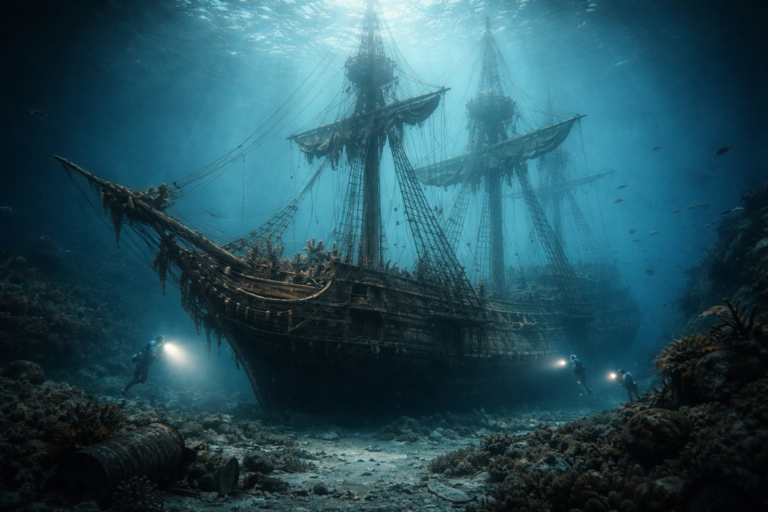
When a centuries-old shipwreck was discovered off Australia’s southern coast this spring, archaeologists at first thought the sonar signature was a rock formation. Instead they found the timber hull of an 18th-century explorer’s vessel, remarkably intact and lying upright on the seabed. After 250 years underwater, this lost ship is being hailed as a true time capsule from another era — an unprecedented window into early navigation, material culture, and colonial-era encounters.
The discovery
The vessel was located during a routine marine survey for an environmental impact assessment. Remote-operated vehicles revealed a full hull framed in original timbers, rigging fastenings still in place, and artifacts strewn in protected alcoves. Marine archaeologists brought in conservators, historians, and Indigenous cultural liaison officers to assemble a rapid-response team. Preliminary dating of timbers and artifacts, along with historical records of missing exploration ships, suggests the wreck belongs to a small exploratory vessel that vanished in the late 1700s.
How it survived so well
Several factors combined to keep the ship almost untouched for a quarter-millennium:
- Low oxygen: The wreck sits in a cold, low-oxygen layer of water and fine sediment that greatly reduced wood-eating organisms and bacterial decay.
- Protected site: A sheltered seafloor depression and surrounding sandbanks prevented strong currents and large storms from breaking the hull apart.
- Rapid burial: Shifting sands appear to have partially buried the ship soon after it sank, further isolating it from biological and mechanical damage.
- Temperate waters: Colder water temperatures slowed chemical degradation of metals and organic materials.
These conditions created a near-ideal underwater archive. Where many wrecks exist as scattered timbers and encrusted debris fields, this ship reads like a deliberately laid-out room from the past.
What researchers have found so far
Conservators have catalogued a remarkable range of items that together tell a vivid story of life aboard an exploratory ship:
- Wooden galley fittings, barrels, and storage chests that still hold preserved organic residues.
- Navigation instruments: a brass octant, compasses, and a lead-lined binnacle.
- Personal effects: leather boots, clothing fragments, carved wooden toys, and a pocket-sized devotional book.
- Cargo remains: samples of trade goods, a small collection of botanical specimens in sealed jars, and cooking pots.
- Ship’s equipment: a portion of the mast, rove blocks, and iron fastenings bearing maker marks.
- Written material: fragments of a logbook and loose handwritten pages found in a sealed chest — preliminary conservator notes say ink and paper are legible under imaging.
Each find is being recorded in situ, photographed, and then carefully removed for desalination and conservation onshore. Even small items like buttons and nails are providing crucial clues to provenance and date.
Why this matters
This discovery matters for several reasons:
- Historical insight: The ship provides primary evidence of 18th-century exploration techniques, provisioning, and the day-to-day lives of crew members.
- Cultural context: Artifacts may illuminate early contact between European explorers and Indigenous Australians, informing both national history and local Indigenous narratives.
- Scientific value: Preserved organic materials allow for dendrochronology, textile analysis, and DNA testing that are rarely possible with older wrecks.
- Public engagement: A discovery of this scale can inspire museum exhibitions, documentaries, and educational programs that connect people with maritime heritage.
Conservation and ethical considerations
Recovering such a site presents major challenges. Conservators will need years to stabilize organic materials; iron artifacts will require electrochemical treatment; delicate manuscripts must be desalinated and imaged using non-invasive multispectral techniques. At the same time, researchers are working closely with Indigenous custodians to respect cultural sensitivities and to ensure any human remains or culturally significant items are handled appropriately.
Legal frameworks for underwater heritage protection are being activated to guard the site from looting and unauthorized diving. The team is planning a phased approach: documentation in situ, careful salvage of the most at-risk items, long-term conservation, and a collaborative exhibition strategy.
What comes next
Over coming months, multidisciplinary teams will continue excavation, conservation, and archival work. Scholars expect this wreck will reshape parts of our understanding of 18th-century exploration and the early maritime history of Australia. For the public, the project promises a rare glimpse into a frozen moment of the past — a genuine time capsule rising from the deep to tell its story after 250 years.