
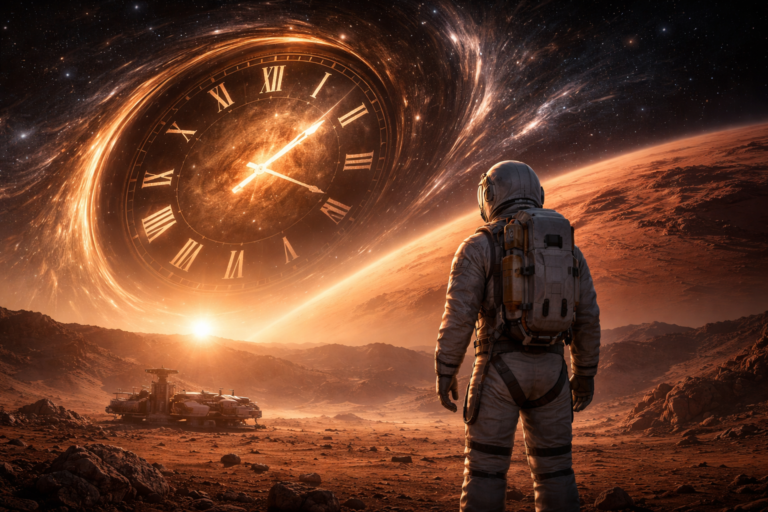
More than a century ago, Albert Einstein’s theory of relativity predicted that time is not constant—it changes depending on gravity and motion. Today, that prediction has been scientifically confirmed on Mars, where time flows slightly faster than on Earth.
This discovery is not just theoretical. It has real-world implications for future Mars missions, navigation systems, communication networks, and even human survival in space. Scientists now know that ignoring these tiny differences could lead to serious errors in interplanetary operations.
Understanding Einstein’s Prediction
Einstein’s General Theory of Relativity explains that time slows down in stronger gravitational fields and speeds up in weaker ones.
- Strong gravity (like Earth) → time moves slightly slower
- Weak gravity (like Mars) → time moves slightly faster
This phenomenon is known as gravitational time dilation.
Additionally, motion also affects time. Faster movement can slow time relative to a stationary observer, adding another layer of complexity.
Why Time Moves Faster on Mars
Mars is smaller and less massive than Earth, which means it has weaker gravity. Because of this:
- Time passes faster on Mars than on Earth
- The difference is tiny—but measurable and significant over time
Scientific calculations show:
- Clocks on Mars tick about 477 microseconds faster per Earth day
- This difference can vary by ±226 microseconds depending on Mars’ orbit
That’s less than a millisecond per day—but over months and years, it adds up.
Mars Time Vs Earth Time: Key Differences
| Factor | Earth | Mars |
|---|---|---|
| Gravity Strength | Stronger | Weaker |
| Time Flow | Slightly slower | Slightly faster |
| Daily Time Difference | — | +477 microseconds/day |
| Variation | Minimal | ±226 microseconds/year |
| Day Length | 24 hours | 24h 39m 35s (1 sol) |
The Science Behind the Difference
Time differences on Mars result from three main factors:
1. Gravitational Time Dilation
Mars’ weaker gravity causes clocks to run faster compared to Earth.
2. Orbital Motion
Mars travels around the Sun in a more elliptical orbit, meaning its speed changes throughout the year.
3. Multi-Body Gravitational Effects
The gravitational pull from the Sun, Earth, and other celestial bodies also influences time flow on Mars.
Why This Matters for Future Space Missions
At first glance, a few microseconds may seem irrelevant—but in space exploration, precision is everything.
1. Navigation Systems
Future Mars missions will rely on ultra-precise timing systems, similar to GPS on Earth.
- Even a microsecond error can cause kilometer-scale navigation mistakes
- High-speed communication systems require accuracy within fractions of a microsecond
2. Communication Networks
Mars missions will depend on interplanetary internet systems.
- Time drift could disrupt data synchronization
- Signals between Earth and Mars may become misaligned
3. Autonomous Robotics
Mars rovers and drones require precise timing for:
- Navigation
- Data transmission
- Coordination with orbiters
Even small timing errors could affect mission safety and efficiency.
Impact on Human Missions to Mars
As humanity prepares for long-term Mars colonization, time differences become even more important.
Astronaut Timekeeping
Astronauts may need to operate with:
- Dual time systems (Earth time vs Mars time)
- Custom “Mars clocks” adjusted for relativistic differences
Biological Implications
While humans won’t feel microsecond differences directly:
- Long-term missions may require synchronized biological and mission clocks
- Psychological adaptation to longer Martian days (sols) will also be necessary
Engineering Solutions Being Developed
Scientists and engineers are already working on solutions:
1. Planetary Time Standards
New systems like Mars-specific time scales are being developed to ensure consistency.
2. Relativistic Clock Corrections
Future spacecraft and satellites will include built-in relativistic adjustments to maintain accuracy.
3. Interplanetary Navigation Networks
Similar to GPS, Mars may have its own satellite navigation system, designed with relativistic corrections in mind.
Future Implications for Space Exploration
This discovery goes beyond Mars. It proves that:
- Every planet has its own “time signature”
- Interplanetary travel requires custom time systems
- Future missions to Jupiter, Saturn, and beyond will face even greater relativistic challenges
Einstein’s theory is no longer just academic—it is becoming a practical engineering challenge.
Conclusion
The confirmation that time flows differently on Mars marks a major milestone in both physics and space exploration. What Einstein predicted over a century ago is now shaping the future of human space travel, technology, and planetary colonization.
Although the difference is measured in microseconds, its impact is enormous. As humanity moves toward becoming an interplanetary species, mastering time itself will be just as important as mastering rockets and propulsion systems.
Mars has shown us that time is not universal—and adapting to that reality is the next great challenge of space exploration.
More than a century ago, Albert Einstein’s theory of relativity predicted that time is not constant—it changes depending on gravity and motion. Today, that prediction has been scientifically confirmed on Mars, where time flows slightly faster than on Earth.
This discovery is not just theoretical. It has real-world implications for future Mars missions, navigation systems, communication networks, and even human survival in space. Scientists now know that ignoring these tiny differences could lead to serious errors in interplanetary operations.