
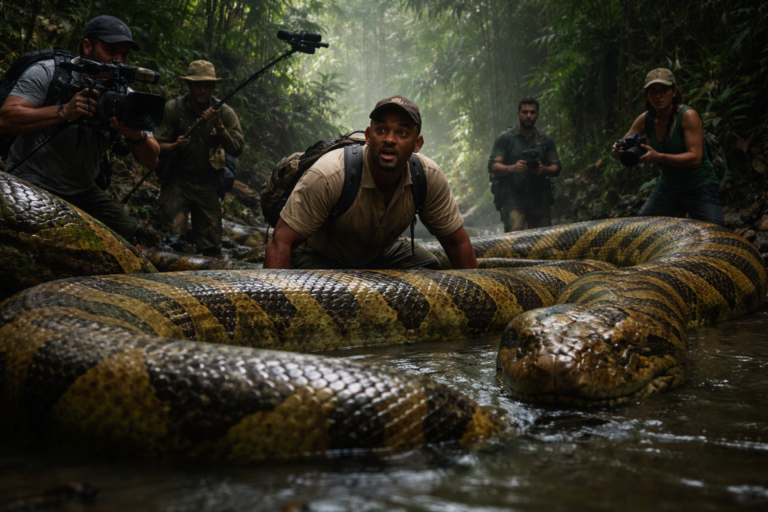
Filmmaking in the world’s largest rainforest often produces unexpected encounters, but recent reports of a 7.5-metre anaconda discovered during the shoot of a Will Smith documentary have captured global attention. The claim—if verified—would represent one of the largest anacondas ever documented and highlights both the mystery and fragility of Amazonian wildlife.
The discovery: dramatic footage and cautious claims
According to accounts from the film crew, the giant snake was encountered on the banks of a remote Amazon tributary while filming for a wildlife segment featuring actor Will Smith. Crewmembers reportedly captured footage that shows a massive, olive-green snake coiled near the waterline. Early estimations put its length at roughly 7.5 metres, a size that would dwarf most confirmed records for Eunectes murinus, commonly known as the green anaconda.
It’s important to stress that these initial numbers are unconfirmed. In high-profile encounters like this, length estimates based on video and photos can be misleading without proper measurements taken under scientific conditions. Herpetologists and independent experts will need access to high-quality imagery, metadata, and ideally on-site measurements before accepting the figure.
Why a 7.5-metre anaconda would be significant
Green anacondas are the heaviest snakes on Earth and are known to reach considerable lengths; most adults fall between 3 and 5 metres. Reports of specimens above 6 metres exist but are rare and often disputed. A verified 7.5-metre anaconda would be noteworthy for several reasons:
- It would challenge current understanding of growth limits for the species.
- It could provide insight into the health and richness of the local ecosystem that supports such large predators.
- It would draw attention to the Amazon’s remaining intact habitats where megafauna can thrive.
Such a discovery also fuels public fascination with the Amazon, drawing eyes (and funding) toward conservation matters that affect both wildlife and indigenous communities.
How scientists verify giant snake reports
Given how easily size can be misjudged in photographs or clips, researchers follow careful protocols before confirming extraordinary claims:
- Photogrammetry: Using multiple images or video frames with known reference distances to calculate accurate lengths.
- On-site measurement: When safe and feasible, trained teams measure the snake directly after humane capture or with laser measurement tools.
- Tissue samples: Genetic analysis can confirm species identification and reveal population-level information.
- Expert review: Herpetologists examine scale counts, head shape, and other morphological features visible in the footage.
Until such steps are completed and peer-reviewed, any headline figure should be treated as provisional.
Filmmaking, ethics, and conservation opportunities
High-profile documentary shoots have a dual role: they can bring rare footage to the public and create opportunities for scientific collaboration. Responsible filmmakers work closely with local guides, researchers, and authorities to ensure encounters are documented ethically and that animals are not harassed or harmed.
Potential positives from this incident include:
- Scientific collaboration: Providing researchers with raw footage and location data for verification and study.
- Public awareness: A compelling story can shift public attention toward Amazon conservation and the threats of deforestation, illegal mining, and climate change.
- Community engagement: Highlighting the knowledge and stewardship of Indigenous peoples who often possess deep ecological understanding of these species.
However, there are risks if sensationalism takes precedence: disturbance to animals, unregulated tourist influxes, and pressure on local ecosystems. Balancing storytelling with stewardship is crucial.
What to watch for next
If this sighting is more than a sensational headline, expect the following developments:
- Independent verification from herpetologists or conservation organizations.
- Release of high-resolution footage or stills with geotagging and timestamps.
- Possible field studies to look for repeat sightings or signs of a breeding population.
- Statements from the documentary team outlining how the animal was documented and what measures were taken to protect it.
Final thoughts
The idea of a 7.5-metre anaconda discovered during a Will Smith documentary shoot is thrilling, but scientific rigor must follow the excitement. Whether the snake ultimately measures that extraordinary length or not, the story underscores how much of the Amazon remains unknown and why responsible exploration and conservation are vital. If the footage leads to collaboration between filmmakers and scientists, it could provide both a verified natural record and a powerful vehicle for protecting one of the planet’s most important ecosystems.