
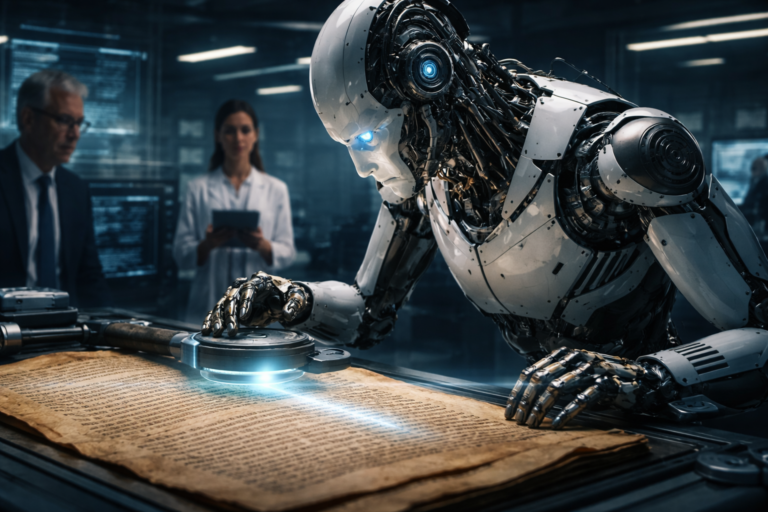
Imagine a headline that reads: “AI detector suggests one of history’s most important texts may not be human-authored.” The shock is immediate. Which text? How could a machine make that claim? And what does it mean for scholarship, faith, and public trust in cultural heritage?
This hypothetical — or emerging — scenario is already playing out in labs and newsrooms as machine-learning tools designed to detect AI-generated writing are applied to old manuscripts and classic works. The result: sometimes surprising flags, sometimes confusion, and always a timely reminder that tools are not answers.
How an AI detector could make such a claim
AI detectors work by recognizing statistical patterns in text: word choice, sentence structure, punctuation rhythms, and other distributional features. Modern detectors are often trained on a mix of human and machine-generated content, and they learn to map stylistic fingerprints to likely origins.
When applied to historical texts, several things can skew results:
- Archaic vocabulary and uncommon syntax look unusual to models trained on contemporary language.
- Scribal variations, later edits, or translated copies introduce patterns detectors didn’t see in their training data.
- OCR errors, digitization artifacts, and incomplete manuscripts add noise that resembles machine output to an algorithm.
So an AI detector might flag a canonical text not because a computer wrote it centuries ago, but because its style departs from the models’ learned norms.
Why scholars should care — and why they shouldn’t panic
A detector’s alert can be useful. It can prompt closer examination of textual transmission, revisions, and interpolation. It might point toward later editorial layers or reveal that a passage was added by a subsequent hand — exactly the kinds of questions textual critics and historians already investigate.
But a single algorithmic flag is not proof of non-human authorship. Humanistic inquiry relies on multiple lines of evidence:
- Paleography and codicology (handwriting and book-making practices)
- Radiocarbon dating of materials
- Historical provenance and archival records
- Stylistic and philological analysis by experts
Treating AI detectors as another lens rather than a judge helps keep scholarship rigorous.
The limitations of current AI tools
Several technical and conceptual limits make detectors unreliable for historical texts:
- Training data bias: Many models are trained on web text, social media, and contemporary publishing — not medieval charters or ancient poetry.
- False positives: Unusual human writing can be misclassified as AI-generated.
- Overconfidence: Models may provide a probability score that users misread as definitive.
- Lack of contextual understanding: Detectors can’t account for authorship conventions, collaborative composition, or translation histories.
Recognizing these boundaries is essential before issuing dramatic claims about the “origin” of a text.
Implications for public discourse and heritage
When a detector’s output becomes a sensational headline, public trust can wobble. Communities that anchor identity, religion, or national history in a text may feel threatened by machine-generated doubts. Conversely, trolls and bad actors could weaponize algorithmic ambiguity to sow confusion.
To prevent harm:
- Communicate findings carefully, emphasizing uncertainty and context.
- Involve subject-matter experts before releasing public-facing conclusions.
- Encourage open discussion about what evidence is decisive and what remains speculative.
A constructive path forward
AI tools are here to stay. Rather than banning their use in humanities research, integrate them responsibly. Best practices include:
- Use detectors as one of several analytical methods, not the sole arbiter.
- Cross-validate findings with traditional scholarly techniques.
- Share datasets and methodologies openly to allow replication.
- Train models on diverse corpora that include historical registers and manuscript transcriptions.
- Educate journalists and the public about model limitations and appropriate interpretations.
Conclusion: tool, not tribunal
An AI detector questioning the human origin of a major text is a provocative prompt, not a verdict. It can catalyze fresh inquiry and uncover overlooked problems in transmission and preservation. But it can also mislead if treated uncritically.
The future of textual scholarship will be hybrid: a dialogue between computational analytics and deep human expertise. When detectors raise questions, scholars should welcome the chance to reexamine evidence — but they should also insist on measured, multidisciplinary responses that respect both the power and the limits of machine judgment.