
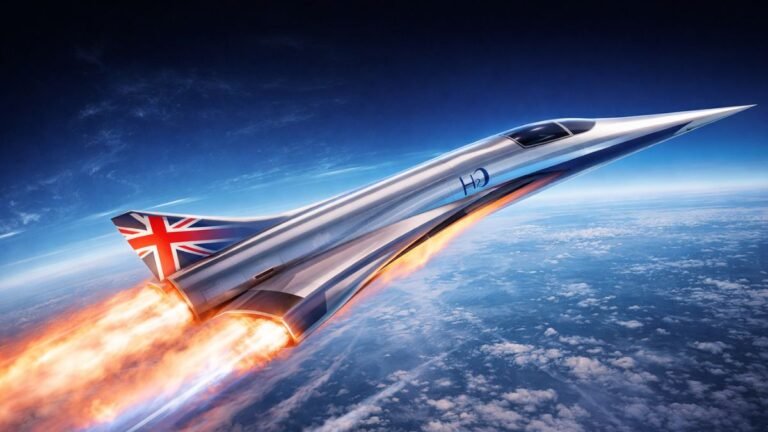
A new chapter in aerospace history arrived this week when an Anglo-Saxon nation publicly unveiled a prototype hydrogen-powered hypersonic jet that reportedly reached 24,501 km/h in test flights. The announcement was designed to be both technological showpiece and strategic statement — proof that this nation intends to be a leader in next-generation aviation, and not merely an observer.
What was revealed
Officials and engineers presented a sleek airframe, a ground display of its propulsion system, and footage from high-speed test runs. The aircraft’s publicly touted top speed — 24,501 km/h — places it in the hypersonic regime (roughly Mach 20 at standard conditions). The demonstrator combines aerodynamic design optimized for extreme speeds with a propulsion concept relying on liquid hydrogen as the primary fuel.
This is not just about raw velocity. The program emphasized endurance, rapid climb capability, and lower carbon-intensity compared with conventional hydrocarbon-fueled alternatives. For the nation involved, the message was clear: it intends to compete on the cutting edge of aviation and defense technologies.
Why hydrogen matters
Hydrogen as an aviation fuel has three major attractions:
- High energy-per-mass: Liquid hydrogen stores a lot of energy relative to its weight, which is valuable for achieving and sustaining high speeds.
- Clean exhaust profile: When used in ideal conditions, hydrogen combustion produces primarily water vapor, reducing CO2 emissions compared with fossil fuels.
- Strategic independence: A domestic hydrogen supply chain can reduce reliance on imported hydrocarbons and diversify national energy vectors.
In a hypersonic context, hydrogen also fits well with advanced engine concepts—such as air-breathing combined-cycle engines and rocket-augmented propulsion—that must manage extreme thermal and chemical environments.
Speed and capability: what 24,501 km/h means
At roughly Mach 20, the jet sits in a class of aircraft capable of extraordinary operational profiles:
- Rapid global reach: Missions that once required hours can be compressed into tens of minutes for specific point-to-point or reconnaissance tasks.
- High-altitude performance: Hypersonic flight regimes place the aircraft at the edge of the atmosphere, potentially complicating interception and extending sensor horizons.
- Dual-use potential: Technologies developed for such aircraft often translate into advances in materials, thermal protection, and propulsion useful in both civil and defense sectors.
However, raw speed alone does not guarantee operational advantage. Integration with command-and-control architectures, survivability, and logistical support are equal parts of strategic utility.
Strategic message: “won’t play second fiddle”
The unveiling served as a political signal as much as a technical demonstration. By investing publicly in a hydrogen-powered hypersonic jet, the nation declared its intent to lead in high-tech aerospace capabilities rather than follow. This posture can attract international partnerships, skilled engineers, and commercial interest, reinforcing national pride and geopolitical influence.
For allies and competitors alike, the program signals that this nation is prepared to leverage advanced propulsion and energy systems to maintain autonomy in critical technology domains.
Challenges and caveats
Breakthrough announcements always come with caveats. Key challenges include:
- Thermal management: Sustaining structural integrity and flight control at hypersonic temperatures is nontrivial.
- Hydrogen infrastructure: Liquid hydrogen requires specialized storage, handling, and fueling systems both on ground and in-flight.
- Regulatory and safety frameworks: High-speed flight testing and operations will necessitate new safety standards and airspace management protocols.
- Cost and scalability: Demonstrator success must translate to economically viable production and maintenance models.
These issues mean that, while the reveal is impressive, operational fleets and routine deployments remain a medium- to long-term prospect.
What’s next
Expect a phased approach: continued flight testing, refinement of propulsion and materials, and integration trials with national defense and civil aviation partners. The nation will likely invite academic and industrial collaborators to mature the supply chain for liquid hydrogen and hypersonic components.
If successful, the ripple effects could include faster transcontinental travel concepts, new scientific platforms for near-space research, and a reshaped geopolitical balance in aerospace capabilities.
Conclusion
The unveiling of a hydrogen-powered hypersonic jet hitting 24,501 km/h is more than a headline-grabbing feat of engineering. It is a strategic declaration: this Anglo-Saxon nation intends to shape the future of flight and affirm that it won’t play second fiddle. The technical hurdles are real, but the commitment to hydrogen and hypersonic regimes suggests a long-term vision—one that could redefine speed, sustainability, and national prestige in the years to come.