
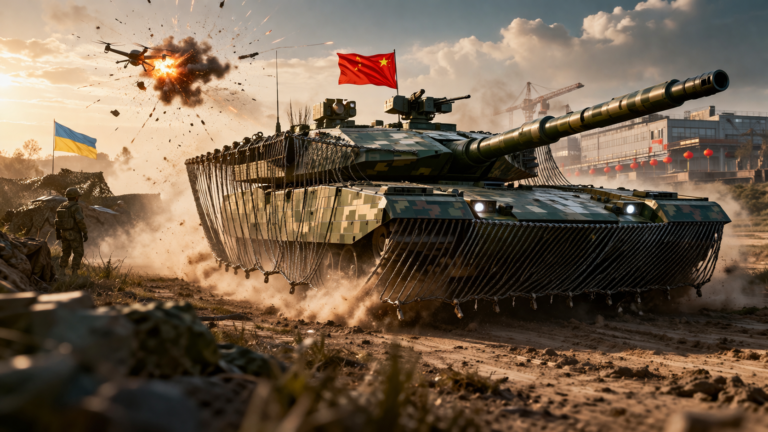
The battlefield is often a crucible for rapid innovation. Over the past few years, Ukraine has become a surprising source of practical, field‑tested ideas — from inexpensive unmanned systems to novel protection measures — that solve immediate problems under fire. Now, according to recent reports and patent filings, one such idea has attracted attention far beyond Europe: a concept originating in Ukraine has reportedly been adapted and patented in China for use on a next‑generation battle tank.
What happened (in plain terms)
A Ukrainian solution — developed to protect crews and vehicles in asymmetric, high‑threat environments — caught the eye of foreign observers. Rather than merely adopting the idea informally, a Chinese entity pursued formal intellectual property protection, registering a patent that appears to cover the core concept. The move signals not just technological interest, but a strategic decision to incorporate and possibly industrialize a proven innovation.
This kind of cross‑border technology transfer is not new. What stands out here is the speed and the context: an idea born out of urgent, improvised conditions is being translated into official patents and state‑level acquisition programs.
Why this matters
Military innovation rarely follows a straight path from lab to battlefield. Ukraine’s hotly iterated solutions are attractive because they are:
- Battle‑tested, not theoretical.
- Cost‑effective and relatively simple to produce.
- Designed to solve specific, modern threats (drones, top‑attack munitions, electronic warfare).
When another major power patents a concept that originated on the battlefield, it raises several implications:
- Strategic uptake: Patents can be an early indicator that a concept will be incorporated into future platforms, making the innovation part of broader doctrine and procurement.
- Industrial scaling: Patenting implies intentions to produce at scale, turning a field expedient into a standardized system.
- Recognition of efficacy: Formal intellectual property filings are—implicitly—an acknowledgment that the idea has value beyond its original context.
What this does — and does not — mean
It’s important to separate symbolism from substance. A patent does not equal immediate battlefield dominance. Implementation requires integration with a vehicle’s design, logistics for production and maintenance, and doctrinal changes for crew training and tactics.
Equally, a patent doesn’t erase the origin story. The fact that an idea from Ukraine inspired foreign patents underscores how conflict zones can be incubators of practical innovation. It also raises questions about intellectual ownership: who benefits from battlefield‑born solutions, and how should credit and compensation (if any) flow?
Broader lessons for military innovation
Several takeaways apply not just to militaries but to governments and industry:
- Practicality trumps novelty: The most influential innovations are often the simplest, most reliable fixes that solve immediate problems.
- Observability accelerates adoption: Solutions that are visible on the battlefield are more likely to be studied, copied, and adapted.
- Open ecosystems matter: Networks—of soldiers, engineers, NGOs, and private firms—enable fast iteration. That ecosystem is what turned a local idea into an international patent.
- Policy and ethics lag technology: The formalization of ideas via patents invites debate over ownership, compensation, and the ethics of profiting from wartime ingenuity.
Looking ahead
If the reported patent is a harbinger, expect to see more convergence between grassroots battlefield solutions and formal defense procurement worldwide. Major powers will continue mining conflict zones for practical ideas, while smaller innovators will need better channels to protect and benefit from their creations.
For Ukraine, the episode is a double‑edged sword: validation of ingenuity on the one hand, and the risk that homegrown ideas will be lifted and industrialized by others on the other. For the wider world, it’s a reminder that innovation often arrives where necessity is greatest — and that the trajectory from improvised field fix to state‑of‑the‑art system can be surprisingly short.
Final thought
The patenting of a Ukrainian‑inspired idea by China is more than a legal filing; it’s a snapshot of modern technological competition, where battlefield experience, intellectual property, and geopolitical ambition intersect. How nations and inventors respond will shape the next generation of military innovation.