
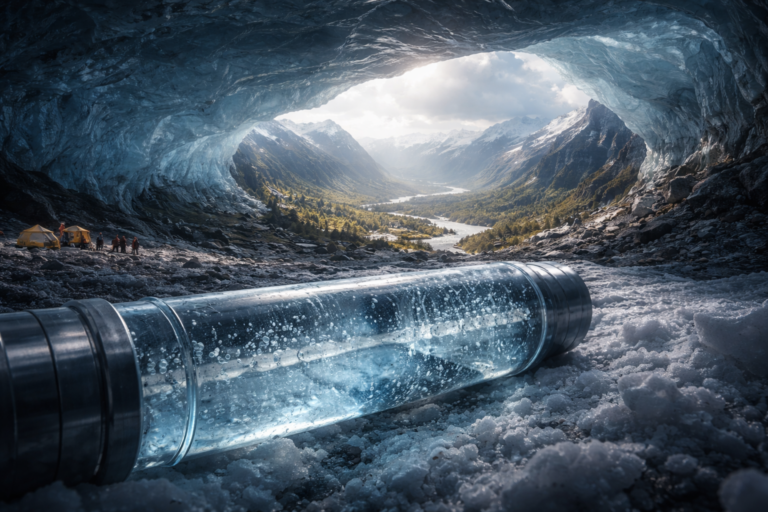
Glaciers and ice sheets hide entire landscapes beneath them: valleys, river systems, peat layers, and even forests once exposed to sunlight. Because these terrains lie under kilometers of ice, direct dating of the landscape surface is often impossible. Instead, scientists rely on indirect clues — and one of the most powerful of those clues is trapped gases.
The phrase “Ancient landscapes under ice are dated indirectly through trapped gases” sums up a growing approach in paleocryology and geochronology. By studying gases preserved in ice, in sealed sediment pockets, or dissolved in subglacial waters, researchers can build timelines for when a landscape was covered, altered, or last exposed.
How trapped gases record time
When snow compacts into ice, it traps tiny air bubbles that preserve a sample of the atmosphere at the time of entrapment. Those bubbles are time capsules: they contain the same mix of gases, isotopes, and trace chemicals that existed when the snow fell. Similarly, sediments and organic matter buried beneath glaciers can hold gases and biomarkers in pore spaces or within sealed mineral matrices.
Analyses of these trapped gases provide several kinds of geochronological information:
- Isotopic signatures (for example, radiocarbon in CO2 or methane) that can be used to estimate ages.
- Changes in greenhouse gas concentrations (CO2, CH4) that align with known climatic transitions, offering stratigraphic tie-points.
- Noble gas abundances and isotopes that reflect past temperatures and gas sources, helping to correlate ice layers with other records.
Because the trapped gas record in ice is continuous and often well-stratified, it can be used to infer when the underlying landscape became isolated from the atmosphere.
Common approaches and tools
Scientists combine multiple techniques to extract age estimates from trapped gases:
- Ice-core chronologies: Long ice cores come with well-established age models based on layer counting, volcanic ash markers, and isotopic cycles. Matching gas compositions in bubbles to those layers anchors the trapped-gas record in time.
- Radiocarbon and radiogenic isotopes: Organic gases (or gas-derived carbon) trapped with sediments can sometimes be dated using radiocarbon (14C). Where applicable, this gives a direct age for when that organic matter was last in contact with the atmosphere.
- Gas-isotope correlations: Global changes in atmospheric methane or CO2 are recorded synchronously in many ice cores. If a trapped-gas signal in a subglacial sample matches a known atmospheric event, it provides an indirect timestamp.
- Pore-water and sediment gas analyses: Sealed pockets and anoxic sediments beneath ice can preserve ancient gases. Measuring their composition and isotopes helps reconstruct the timing and conditions of burial.
These methods are often used in combination with other dating techniques — for example, cosmogenic-nuclide exposure dating of nearby nunataks (exposed peaks) or luminescence dating of outflow sediments — to build a robust chronology.
Why indirect dating matters
Direct sampling of subglacial bedrock or buried soils is technically difficult and expensive. Even when reachable, those materials can be altered by ice dynamics or biological activity, complicating age interpretations.
Trapped gases provide a complementary record that is:
- Broadly preserved across ice sheets, offering regional context.
- Sensitive to atmospheric composition changes that are globally synchronous.
- Often less altered than surface materials subjected to erosion or transport.
Using trapped gases, researchers have been able to infer when parts of an ice sheet advanced over a landscape, how long organic soil horizons remained intact beneath ice, and when subglacial ecosystems were sequestered from the surface world.
Limitations and uncertainties
Indirect dating through trapped gases is powerful but not foolproof. Key challenges include:
- Gas mixing and diffusion: Some gas exchange can occur within firn (the porous layer above compact ice) or through cracks, which can blur ages.
- Gas-age/ice-age differences: Bubbles become sealed at a different depth than the surrounding ice layers, so careful correction is needed to match gas ages to ice ages.
- Source ambiguity: Trapped gases in sediments may derive from local biological activity, ancient atmospheric air, or deep geologic sources; disentangling these requires careful isotopic work.
- Resolution limits: Gas records integrate signals over time; short events can be smoothed out.
Despite these caveats, trapped-gas approaches remain among the best ways to place ancient subglacial landscapes into a temporal framework.
Conclusion
Ancient landscapes hidden beneath ice sheets present a tantalizing record of past climates, ecosystems, and geological processes. Because direct dating is often impractical, the sentence “Ancient landscapes under ice are dated indirectly through trapped gases” aptly describes a central strategy used by researchers today. By reading the isotopic and compositional signatures locked in ice bubbles and sealed sediments, scientists can piece together when landscapes were buried, how long they remained isolated, and how the Earth’s surface and atmosphere changed over glacial cycles.