
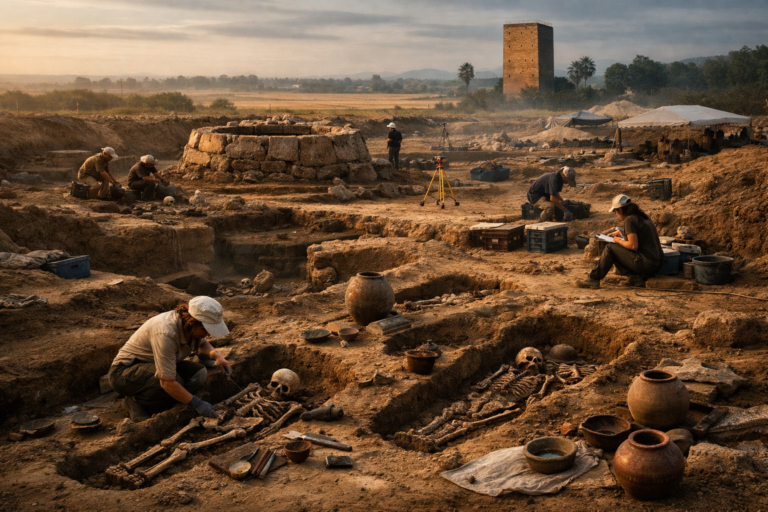
Archaeology in Spain has reached a remarkable turning point after the discovery of an exceptional Bronze Age necropolis in Seville, offering new insights into the lives, beliefs, and burial customs of prehistoric communities on the Iberian Peninsula. The excavation revealed a complex network of tombs, artifacts, and human remains dating back thousands of years, providing a rare window into a society that thrived during the Bronze Age (approximately 2200–800 BCE).
Researchers describe the site as one of the most significant burial complexes found in southern Spain in recent years. The findings are expected to reshape historians’ understanding of ancient social organization, trade networks, and ritual practices across the region.
Discovery Of The Bronze Age Necropolis
The discovery began when archaeologists noticed subtle irregularities in soil patterns in agricultural land near Seville, in southern Spain. Aerial surveys and ground analysis revealed underground structures suggesting human activity. Once excavation started, researchers uncovered dozens of carefully arranged graves and burial chambers beneath layers of soil.
Unlike scattered burial sites often found in prehistoric landscapes, this necropolis shows deliberate planning and spatial organization, indicating a structured community with defined funerary rituals.
Archaeologists believe the cemetery was used over multiple generations, serving as a collective resting place for a Bronze Age settlement located nearby.
Key Facts About The Seville Bronze Age Necropolis
| Feature | Details |
|---|---|
| Location | Near Seville, Andalusia, Spain |
| Historical Period | Bronze Age (approx. 2200–800 BCE) |
| Site Type | Necropolis (ancient cemetery) |
| Major Discoveries | Tombs, burial chambers, pottery, jewelry, human remains |
| Excavation Method | Aerial reconnaissance and ground excavation |
| Number Of Tombs | Multiple graves discovered, including collective burials |
| Cultural Importance | Offers insight into prehistoric Iberian society and burial practices |
Size And Structure Of The Ancient Cemetery
The necropolis forms part of a larger archaeological landscape linked to Valencina de la Concepción, one of Europe’s largest prehistoric burial complexes. This extensive site spans more than 400 hectares, demonstrating the scale and importance of the settlement that once existed in the region.
The burial complex contains several types of graves:
- Single burials, where one individual was placed in a tomb
- Collective graves, where multiple people were buried together
- Chamber tombs, sometimes used repeatedly over generations
These diverse burial styles suggest the existence of different social or family groups within the community.
Artifacts And Objects Found In The Tombs
Archaeologists recovered a wide range of artifacts placed alongside the deceased. These objects were likely meant to accompany individuals into the afterlife and reveal important information about Bronze Age culture.
Among the most notable discoveries are:
- Ceramic pottery vessels
- Jewelry made from precious materials
- Personal ornaments and decorative items
- Tools and everyday objects
Each artifact provides clues about the technology, craftsmanship, and economic activity of the time.
Some items also hint at long-distance trade networks, suggesting that prehistoric Iberian communities were connected with other Mediterranean societies.
What The Human Remains Reveal
The human skeletons discovered in the necropolis are extremely valuable to scientists. By studying bones and burial arrangements, researchers can reconstruct the lives of people who lived thousands of years ago.
Bioarchaeological analysis can determine:
- Age at death
- Sex of the individuals
- Possible causes of death
- Diet and health conditions
- Evidence of physical labor or injuries
These analyses allow archaeologists to understand the daily life, hardships, and social structure of Bronze Age communities.
Early findings suggest the population experienced intense physical work and environmental challenges, common in prehistoric agrarian societies.
Why This Discovery Is So Important
The Seville necropolis is considered a major milestone in European archaeology for several reasons.
1. Rare Preservation
The graves and artifacts are unusually well preserved, allowing researchers to reconstruct burial rituals with remarkable precision.
2. Evidence Of Organized Society
The careful layout of tombs suggests a community with structured social organization and shared cultural beliefs.
3. Insights Into Bronze Age Iberia
The discovery contributes to a growing body of evidence showing that Iberian societies were complex, interconnected, and technologically advanced during the Bronze Age.
4. Cultural Heritage Significance
For Spain, the site represents an important piece of national history and highlights the rich prehistoric heritage of Andalusia.
Archaeological Methods Used In The Excavation
Modern archaeological techniques played a key role in the discovery and study of the necropolis.
Researchers used:
- Aerial reconnaissance and satellite imaging
- Geophysical scanning
- Careful stratigraphic excavation
- Laboratory analysis of bones and artifacts
These methods allow scientists to uncover information while preserving the site for future research.
Preservation And Future Research Plans
Spanish archaeologists and heritage authorities are working to protect and conserve the necropolis. Plans include:
- Continued excavation and documentation
- Scientific analysis of artifacts and remains
- Potential creation of educational exhibitions and visitor programs
Researchers believe the site may still contain many undiscovered structures and graves, meaning years of study remain ahead.
Future research could reveal more about Bronze Age religion, social hierarchy, and trade connections across Europe.
The Broader Impact On European History
The Seville necropolis discovery is not just important for Spain—it contributes to understanding the entire Bronze Age world.
Archaeologists are increasingly discovering that prehistoric societies across Europe were connected through trade, migration, and shared technologies. These networks helped spread metals, cultural ideas, and innovations throughout the continent.
The newly uncovered necropolis may provide crucial evidence about how communities in the Iberian Peninsula interacted with the wider Mediterranean and European world.
Conclusion
The discovery of the Bronze Age necropolis in Seville represents one of the most exciting archaeological breakthroughs in Spain in recent years. With dozens of graves, diverse burial types, and a wealth of artifacts, the site provides an extraordinary glimpse into the lives of prehistoric Iberian communities.
Beyond its immediate scientific value, the necropolis reminds us that beneath modern landscapes lie traces of civilizations that shaped Europe thousands of years ago. As excavations continue, archaeologists expect this remarkable site to reveal even more secrets about Bronze Age culture, social structures, and human history.