
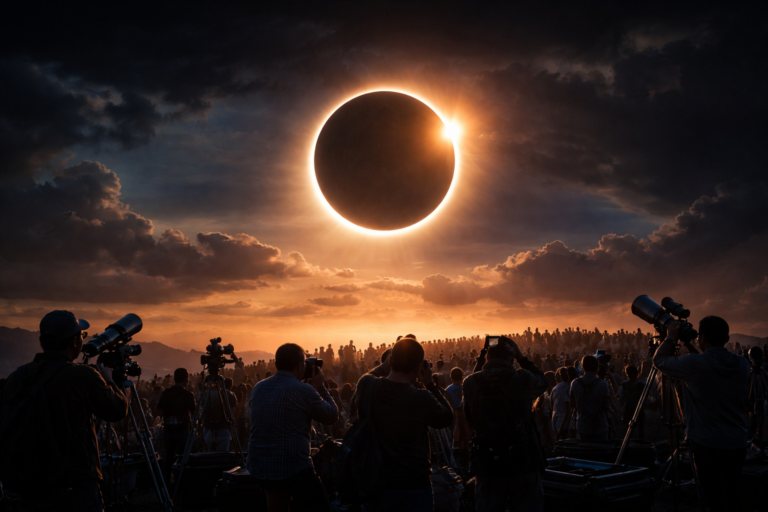
Astronomers have confirmed the date for what is being called the century’s longest solar eclipse, a rare celestial event that will briefly turn day into night and create an extraordinary spectacle across several regions. Scientists, skywatchers, and travel planners are already preparing for a breathtaking display that will offer both unforgettable views and valuable scientific opportunities.
What makes this eclipse special?
This eclipse stands out because of its unusually long period of totality — the interval during which the Moon completely covers the Sun. The length of totality depends on the precise geometry of the Earth, Moon, and Sun at the moment of alignment. Factors like the Moon’s distance from Earth, the Earth’s distance from the Sun, and the angle of the eclipse path all contribute.
A longer totality means more time to observe solar features such as the corona, prominences, and chromospheric activity. For photographers and professional researchers alike, it’s a rare chance to capture phenomena that are normally hidden by the Sun’s bright disk.
Where and when will it be visible?
The confirmed date puts the event within reach of millions of people across several regions along the eclipse’s path of totality. Observers located along that narrow track will experience the full transformation from daylight to twilight and back. Regions outside the central path will still witness a partial eclipse, with a significant portion of the Sun obscured.
Because precise timing and local visibility vary by longitude and latitude, anyone planning to watch should consult official eclipse maps and timing charts from reputable astronomical organizations or local observatories to find the best viewing locations and exact local times.
Safety first: how to watch the eclipse
Never look directly at the Sun without proper protection except during the brief phase of totality when the Sun is completely covered.
- Use ISO-certified solar viewing glasses (ISO 12312-2) for all partial phases.
- Telescopes and binoculars require proper solar filters attached to the front aperture.
- Pinhole projectors and other projection methods are safe, inexpensive ways to observe the eclipse indirectly.
- Only remove eye protection during totality, and replace it immediately as the bright solar disk begins to reappear.
Local astronomy clubs and science centers will often distribute viewing glasses and set up safe viewing events.
What scientists hope to learn
Eclipses provide unique research windows. During this exceptional event, scientists plan to:
- Study the solar corona’s structure and dynamics in greater detail.
- Observe changes in the Sun’s magnetic field and plasma flows.
- Monitor Earth’s upper atmosphere response to the sudden decrease in solar radiation.
- Test and calibrate instruments designed for space-based solar observation.
Longer totality extends observation time, improving the quantity and quality of data collected and enabling experiments that require more sustained observation.
Tips for travelers and photographers
- Book accommodations and travel well in advance. Regions along the path of totality often experience a surge in visitors.
- Check historical weather patterns for your chosen viewing area. Clear skies are critical; have a backup location within reach if possible.
- For photography: practice exposure settings beforehand. A total solar eclipse requires different exposures to capture the corona, prominences, and the diamond-ring effect.
- Bring comfortable seating, layers for changing temperatures, and snacks — you’ll likely be waiting for hours around the brief totality window.
A shared human moment
Eclipses have always held cultural and emotional significance. This century’s longest solar eclipse promises not just scientific value but also a shared global experience. Communities along the path will come together for public viewings and festivals, while millions beyond it will watch with partial views or stream coverage online.
Whether you’re a scientist, a photographer, or a curious observer, this confirmed event is a reminder of how celestial mechanics can produce moments of wonder. Prepare safely, plan ahead, and don’t miss what could be one of the most memorable astronomical spectacles of the century.