
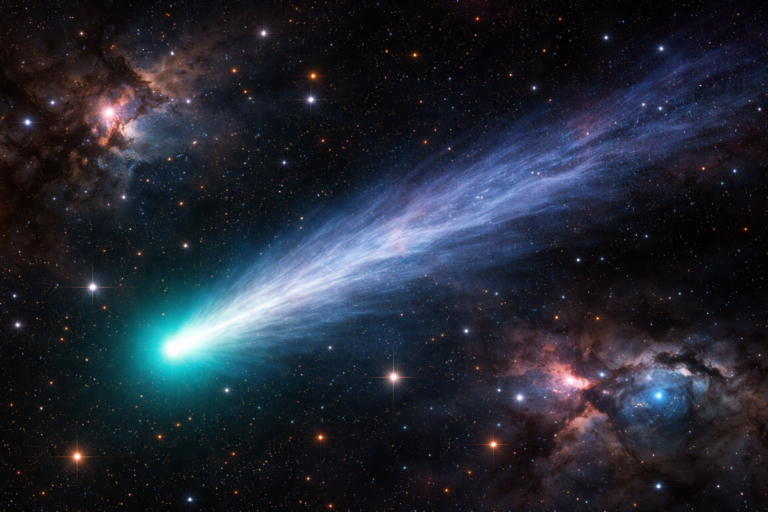
Astronomers release stunning new images of interstellar comet 3I ATLAS captured across multiple observatories — and the results are reshaping how we think about material that drifts between the stars. The newly released image set, compiled from observations taken at different wavelengths and resolutions, reveals an object rich in structure: a bright coma, complex jets, and a long, evolving tail that tell a story about the comet’s origin and composition.
A multi-observatory portrait
No single telescope can fully characterize a passing interstellar visitor. By combining data from multiple observatories — both ground-based and spaceborne — researchers produced a composite view that highlights different physical processes at work.
- Optical imaging maps the dust distribution and reveals fine-scale jets and filamentary structure near the nucleus.
- Infrared observations probe the thermal emission of dust grains and can identify organic or icy components.
- Radio and submillimeter data trace volatile gases released from the comet, allowing astronomers to measure abundances of molecules like CO and H2O (or their proxies).
Together, these datasets provide a richer, more complete picture than any single instrument could deliver. The images show time-variable behavior too: jets that appear, fade, or change direction over days to weeks, indicating ongoing activity as the comet passed through the inner Solar System.
What the images reveal
The new multi-observatory images point to several important findings:
- Coma and jets: A bright, asymmetric coma with multiple narrow jets suggests localized active regions on the comet’s surface. Such jets can originate from pockets of volatile ices that sublimate as sunlight heats the nucleus.
- Dust tail complexity: The tail displays both large-particle dust streams and finer, more diffuse material, implying a range of particle sizes and release velocities.
- Gas signatures: Spectral imaging across different bands highlights varying gas-to-dust ratios. Elevated levels of certain volatiles could hint at formation conditions different from typical Solar System comets.
- Rapid changes: Short-term variability in brightness and structure indicates a dynamically evolving surface, possibly driven by thermal stresses or rotational effects.
These observational signatures are the kinds of clues scientists use to infer where and how an object formed. In the case of an interstellar comet, differences in composition or activity patterns may reflect a birthplace around another star with distinct chemistry and evolutionary history.
Why this matters
Interstellar objects are precious scientific opportunities. Unlike comets native to our Solar System, an interstellar comet carries material that formed in a different protoplanetary disk. Studying that material lets astronomers:
- Compare planetary formation processes across systems.
- Test models of dust and ice chemistry in diverse environments.
- Gauge how common certain volatiles or refractory materials are beyond our neighborhood.
The images of 3I ATLAS offer the first resolved look at the surface activity and dust environment of a true interstellar comet (as captured across multiple observatories), providing ground truth for theories that previously relied on sparse or unresolved detections.
How astronomers made the composite views
Creating the final images required careful coordination and data processing:
- Time-synced observations to capture the comet at similar rotation phases.
- Cross-calibration of brightness and color scales between instruments.
- Image stacking and filtering to enhance faint structures without sacrificing real detail.
- Spectral integration to map chemical species against morphological features.
This collaborative approach not only improves scientific reliability but also maximizes the scientific return from short-lived observing windows.
What’s next
Follow-up studies will refine measurements of nucleus size, rotation state, and precise composition. Observatories will continue monitoring the comet as it recedes, and archived images will be reanalyzed with improved models. Amateur astronomers may also contribute useful time-series data, especially for tracking rapid changes.
Public releases of the images and animated sequences are expected to appear on participating observatories’ websites, making it possible for educators, students, and space enthusiasts to explore the comet visually.
Final thoughts
The release of these images marks a milestone in interstellar object research. By combining the strengths of multiple observatories, astronomers have delivered an unprecedented, multi-faceted view of 3I ATLAS that will inform studies of planetary system formation for years to come. As more interstellar visitors are found, this collaborative, multi-wavelength approach will remain essential for unlocking the secrets these cosmic travelers carry.