
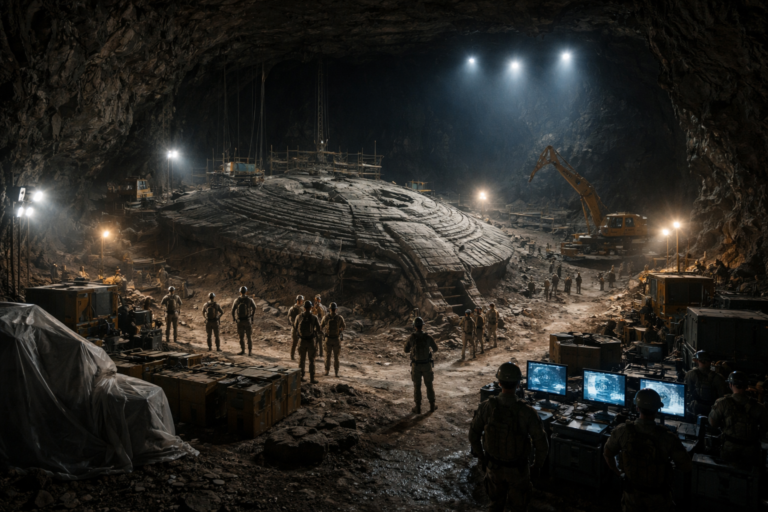
Last week, reports emerged that a military-operated deep-drilling mission reached an unexpected depth of 2,670 meters below the surface and recovered material that specialists are calling a record-breaking discovery. While details remain under verification, the announcement has already ignited intense interest across archaeology, geology, and the life sciences. If confirmed, this find could force us to rethink not only where artifacts and traces of past life can survive, but also how we search for them.
What was discovered?
Initial statements indicate the recovered material includes exceptionally well-preserved organic fragments, stratified sediments with intact microfossils, and technological debris unlike anything cataloged at comparable depths.
Key reported elements:
- Organic tissue fragments and plant microfossils preserved in anoxic conditions.
- Layered sedimentary records offering continuous environmental data.
- Metallic and composite objects that suggest human or proto-technological activity in a previously unexpected context.
Researchers emphasize caution: samples are undergoing rigorous laboratory analysis to determine age, origin, and possible contamination. Military involvement expedited access to extreme depths and high-resolution subsurface tools, but independent scientific validation remains essential.
Why this is record-breaking
Two aspects make the discovery potentially transformative. First, the depth itself—2,670 meters—lies far below the zones where archaeologists traditionally expect to find preserved cultural materials. Second, the quality of preservation reported is unusual: anoxic, low-temperature, and mineral-stable environments at such depths can prevent biochemical breakdown, meaning organic evidence that usually disintegrates at shallower levels could survive for far longer.
If human-made artifacts or biological traces are verified at this depth, it would expand the vertical search space for archaeology and paleontology, opening new archives of past environments and behaviors previously thought inaccessible.
How this could reshape archaeology
- Expanded search frontier: Archaeologists may start collaborating more with deep drilling programs, mining operations, and military subsurface initiatives to explore deeper stratigraphic archives.
- New preservation contexts: Understanding how organic materials survive at extreme depths will refine preservation models and dating techniques.
- Interdisciplinary methodologies: Geophysicists, microbiologists, and materials scientists will likely become permanent partners in excavation and interpretation at depth.
- Rewriting timelines: If evidence of human or proto-human activity is authenticated, chronologies of migration or technology could be reassessed.
These possibilities push archaeology beyond surface digs and shallow stratigraphy, encouraging methods that integrate deep Earth science techniques.
Scientific and ethical challenges
The excitement is tempered by several critical challenges:
- Contamination risk: Drilling can introduce modern materials deep into strata, complicating interpretation.
- Provenance verification: Establishing an unbroken chain of custody and stratigraphic integrity is essential for credible claims.
- Preservation versus exploitation: The involvement of military or commercial entities raises questions about data sharing, custodianship, and the protection of heritage.
- Ethical stewardship: If human remains are present, culturally appropriate treatment, consultation with descendant communities, and legal frameworks must guide actions.
Transparent data release and independent replication will be necessary to move from sensational headlines to solid science.
Immediate next steps
To responsibly assess and capitalize on this find, the scientific community should prioritize:
- Independent sample analysis by multiple labs for dating, isotope, and DNA testing.
- Detailed geophysical surveys to map the depositional context and ensure stratigraphic continuity.
- Formation of an interdisciplinary oversight committee including archaeologists, geologists, ethicists, and relevant stakeholders.
- Public reporting that balances timely updates with scientific rigor.
Looking ahead
Whether the announcement ultimately transforms textbooks or becomes a cautionary tale about premature claims, the episode highlights a broader trend: advances in technology are pushing the boundaries of where we can search for the past. Deep subsurface environments may hold long-preserved records of climate, ecosystems, and possibly cultural traces that conventional archaeology has overlooked.
If the 2,670-meter discovery is validated, we may soon see fieldwork move downward as confidently as it moved outward, with toolkits and ethical frameworks redesigned for a deeper past. The intersection of military capabilities and scientific inquiry will require careful stewardship, but the potential payoff—a richer, more detailed picture of Earth’s history and human experience—could be enormous.
Conclusion
At 2,670 meters below the surface, the military makes a record-breaking discovery that will reshape archaeology only if rigorous science and transparent collaboration follow. The claim has sparked necessary curiosity and caution in equal measure. In the months ahead, researchers will determine whether this find opens a new subterranean chapter in our understanding of the past—or whether it reminds us how much care is needed when we mine the deep for answers.