
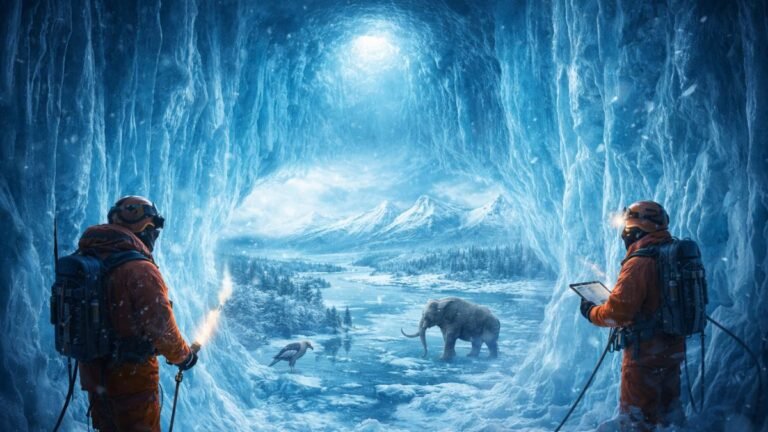
For decades, Antarctica has guarded secrets under its vast, white shell. Now, a recent expedition has pierced that silence: buried beneath two kilometers of Antarctic ice, scientists uncover a lost world frozen in time for 34 million years. The discovery offers an unprecedented window into a long-vanished ecosystem and a clearer record of Earth’s climate transition at the Eocene–Oligocene boundary.
A window to the deep past
Around 34 million years ago, the planet shifted from a warmer, greenhouse state to a cooler climate that allowed large Antarctic ice sheets to form. Sediments and ecosystems trapped beneath the ice since that time are effectively sealed archives. When researchers accessed these layers using ultra-clean drilling and core retrieval, they found organic-rich sediments, fossil pollen, microbial lineages, and chemical markers that together tell a surprising story of life and environment from the dawn of Antarctic glaciation.
How the team reached the frozen archive
Accessing a site two kilometers below the surface required years of planning and international collaboration. Key steps included:
- Designing sterile drilling systems to avoid contamination of ancient material.
- Extracting continuous sediment cores through ice and into subglacial basins.
- Applying radiometric and biostratigraphic dating to constrain ages to about 34 million years.
- Using DNA sequencing, microscopy, and geochemical assays to analyze biological and environmental content.
The combination of physical cores and advanced lab techniques gave scientists both direct fossils and molecular clues about organisms that once lived there.
What they found
The findings are remarkable for both their diversity and their preservation. Highlights include:
- Pollen and plant fragments indicating cold-tolerant forests or shrublands near the coast before full glaciation.
- Fossilized microfauna and abundant microbial mats, suggesting freshwater or marginal marine habitats existed intermittently.
- Organic molecules and isotopic signatures that reveal temperature drops and shifts in ocean chemistry consistent with global cooling.
- Living microbial communities that have persisted in isolation, adapted to cold, dark, and nutrient-poor conditions.
These lines of evidence together support a picture of a landscape transitioning from vegetated coastal areas to expanding ice cover—essentially a snapshot of how life responded to dramatic climate change.
Why this discovery matters
This buried world is important for several reasons:
- Climate insight: The cores provide high-resolution data on how rapidly Antarctic ice advanced and how ecosystems responded, improving models of ice-sheet dynamics and past sea-level change.
- Evolutionary biology: Fossil and genetic records illuminate how polar species adapted—or failed to adapt—during major climate shifts.
- Microbial resilience: Studying isolated microbial lineages expands understanding of life’s limits and long-term survival strategies.
- Planetary analogs: Subglacial, cold, and dark environments on Earth are useful analogs for icy worlds elsewhere in the solar system, informing astrobiology and the search for life on moons like Europa or Enceladus.
Challenges and stewardship
Working with ancient, isolated environments raises ethical and technical challenges. Contamination must be prevented not only to preserve scientific integrity but also to protect these ecosystems. The research team emphasized strict sterilization protocols and international oversight to ensure responsible sampling. Long-term monitoring will be needed to balance scientific inquiry with conservation.
Looking ahead
The discovery beneath two kilometers of Antarctic ice opens new research frontiers. Future work will target adjacent basins to build a regional picture of Antarctic collapse and recovery. Advanced genomic analyses will attempt to reconstruct ecological networks, while refined isotopic studies will map temperature and ocean changes in detail.
Beyond academic interest, these findings are a sobering reminder: Earth has undergone rapid, planet-scale changes before, and the biological and physical responses are complex. By studying what happened 34 million years ago, scientists gain context for the changes unfolding today—and tools to better predict the future.
The buried archive beneath Antarctica is more than frozen history; it’s a lesson in resilience, vulnerability, and the deep connections between climate, life, and ice.