
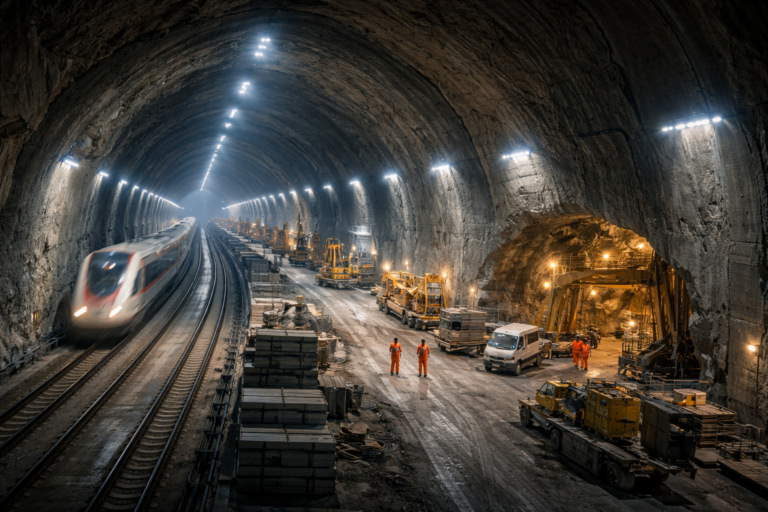
Switzerland’s mountains are famous for their scenic beauty — and for what lies beneath them. By carving tunnels through solid rock for nearly 30 years, Switzerland has quietly built an underground infrastructure larger than many cities above ground. What started as a necessity for better transport has become a deliberate national strategy: use the subsurface for mobility, energy, storage and resilience.
The long tunnel era: more than just train lines
The modern era of Swiss tunneling accelerated with the New Rail Link through the Alps (NRLA), a multi-decade program that moved freight off mountain roads and created fast north–south rail corridors. Projects like the Gotthard Base Tunnel — the world’s longest railway tunnel — the Lötschberg and Ceneri base tunnels are the most visible results. But the NRLA is only part of the story.
Beyond rail, the Swiss have been building subterranean caverns for hydropower, logistics, data hosting, municipal infrastructure and even cultural preservation. Over decades of continuous excavation and engineering, these separate projects have added up to an underground network whose cumulative volume and utility rival the footprint of many above-ground municipalities.
Why go underground?
- Land scarcity: Switzerland’s valleys and protected landscapes limit above-ground expansion. Going underground preserves surface value.
- Environmental protection: Tunneling limits habitat fragmentation, reduces visual impact, and keeps heavy transport away from fragile alpine ecosystems.
- Resilience and safety: Subsurface facilities are less exposed to weather extremes, avalanches and other natural hazards.
- Efficiency: Shorter, straighter tunnels mean faster rail connections and more compact utility corridors.
- Strategic storage and stability: Underground caverns provide stable conditions for storing energy reserves, archives, and sensitive equipment.
What lives under the mountains?
Here are the main categories of Switzerland’s underground infrastructure:
- Transport tunnels
- High-speed and freight rail tunnels that slice through the Alps.
- Road tunnels that shorten travel and bypass mountain passes.
- Hydropower and pumped-storage plants
- Large caverns house turbines and reservoirs, enabling seasonal energy balancing.
- Utilities and logistics
- Underground ducts and caverns for water, sewage, and district energy systems.
- Secure storage for critical supplies.
- Data centers and secure vaults
- Stable temperatures and protection from surface threats make rock caverns attractive to sensitive data and asset storage.
- Research and waste management
- Laboratories and testing facilities use deep geological formations for experiments and long-term containment studies.
- Civil defense and emergency shelters
- Bunkers and reinforced caverns provide emergency space where needed.
Engineering principles and environmental trade-offs
Tunneling in hard rock demands precise geology, cutting-edge machinery and careful planning. Swiss engineers often combine traditional drilling-and-blasting with tunnel-boring machines, adapting techniques to local strata and groundwater conditions. Monitoring and mitigation of rock stress, water ingress and vibrations are continuous concerns.
Environmental trade-offs exist. Excavation produces spoil that must be managed; underground construction can disturb groundwater flows; and the energy and materials used in tunneling have an environmental cost. Switzerland attempts to offset these impacts by reusing excavated rock in construction and restoring disturbed sites, and by ensuring that underground projects provide long-term environmental or social benefits (for instance, removing heavy truck traffic from sensitive valleys).
What this means for cities and societies
An extensive underground layer changes how a small, densely used country is organized. Cities can preserve open space and cultural landscapes while gaining high-capacity infrastructure below. Energy systems become more flexible when large storage caverns and pumped-hydro plants are available. Critical services are more resilient when housed away from surface disruptions.
Switzerland’s approach also offers lessons for other countries facing space constraints or extreme weather: investing underground can be part of a climate-adaptive, land-conserving planning strategy. Yet the cost and local geology will always shape what’s feasible.
Looking forward
The next decades will see continued use of subterranean space — not as a novelty, but as an integrated layer of national infrastructure. As technologies improve, new possibilities emerge: larger underground data hubs, integrated subterranean logistics, and expanded energy-storage caverns supporting renewables.
By carving tunnels through solid rock for nearly 30 years, Switzerland has not only reshaped its transport map; it has built a hidden, multifaceted infrastructure that supports life above ground. The Alps, long a symbol of natural grandeur, are now also a testament to what careful, long-term engineering can achieve beneath the surface.