
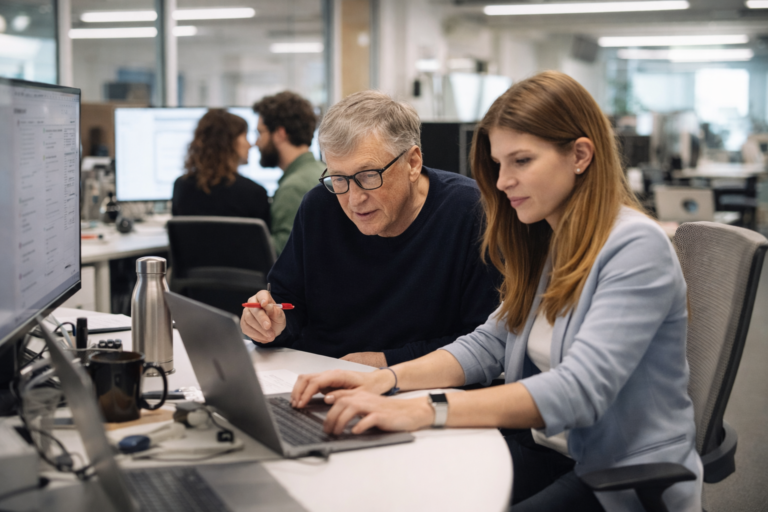
In an era where corporate leadership is often associated with boardrooms and strategy decks, Bill Gates has once again reshaped the narrative. Even in retirement, the Microsoft co-founder demonstrated a powerful leadership lesson by stepping into a customer service role at his daughter’s startup. This real-world action highlighted a critical principle: great leaders stay connected to the front lines.
This article explores the full story, key facts, and why Gates’ move is being seen as a blueprint for modern CEOs.
What Exactly Happened?
In 2025, Bill Gates temporarily worked as a customer service representative at his daughter Phoebe Gates’ startup, Phia.
Phia is an AI-powered fashion shopping platform designed to help users compare prices, discover secondhand alternatives, and make sustainable shopping decisions across thousands of websites.
Instead of investing directly, Gates chose to engage operationally, answering customer queries and experiencing the product firsthand.
Key Highlights Of The Event
| Detail | Information |
|---|---|
| Founder | Phoebe Gates |
| Startup Name | Phia |
| Industry | AI-powered fashion shopping |
| Founded | 2023 |
| Gates’ Role | Customer service representative |
| Duration | Temporary shift |
| Key Learning | Frontline experience provides real insights |
Understanding Phia: The Startup Behind The Story
Phia is not just another startup—it represents the next generation of tech-driven sustainability.
- Built by Phoebe Gates and Sophia Kianni
- Uses AI to analyze prices from 40,000+ websites
- Focuses on affordable and eco-friendly shopping
- Offers both an app and browser extension
Phoebe Gates, born in 2002 and a Stanford graduate, has quickly emerged as a young entrepreneur redefining fashion-tech innovation.
Why Bill Gates Joined The Front Lines
Bill Gates explained that direct interaction with users is the best way to understand a system.
His key belief:
- Technology alone doesn’t reveal user pain points
- Customer conversations provide real feedback
- Frontline roles expose operational gaps
This mindset reflects a deeper philosophy—leadership is not just about decisions but about understanding experiences.
The Leadership Lesson For CEOs
1. Frontline Exposure Builds Better Decision-Making
When CEOs engage directly with customers:
- They identify real-world problems faster
- They reduce dependency on filtered reports
- They improve product-market fit
Gates’ experience reinforces that data is powerful, but human interaction is irreplaceable.
2. Humility Drives Innovation
Despite being one of the world’s wealthiest individuals, Gates took on a role often overlooked by executives.
This sends a strong message:
- No job is too small for a leader
- Respect for employees increases organizational trust
- Innovation often starts from ground-level insights
3. Bridging The Gap Between Leadership And Users
Many companies fail because leaders become disconnected from users.
Gates avoided this by:
- Listening to customer complaints directly
- Observing product usability issues
- Understanding emotional responses of users
This approach ensures customer-centric innovation.
4. Leading By Example
Gates’ move aligns with a growing trend where leaders:
- Take on operational roles
- Experience the product themselves
- Encourage hands-on culture
Such leadership inspires employees to take ownership and stay accountable.
A Broader Trend Among Modern CEOs
Bill Gates is not alone. Several global CEOs have adopted similar strategies:
- Executives working in customer support roles
- Leaders testing their own products
- Founders engaging directly with users
These practices are redefining modern leadership standards, emphasizing:
- Transparency
- Accountability
- Real-time learning
Financial And Business Context
Phoebe Gates’ startup has already gained significant traction:
- Raised $35 million in funding
- Achieved a valuation of around $185 million (early-stage estimate)
Interestingly, Gates has chosen not to heavily fund his children’s ventures, encouraging independence and self-made success.
This adds another layer to the story—support without dependency.
Why This Matters For The Future Of Leadership
The corporate world is evolving rapidly, driven by:
- Artificial intelligence
- Customer-centric business models
- Real-time feedback loops
In this environment, CEOs who remain disconnected risk:
- Poor decision-making
- Weak product alignment
- Declining customer satisfaction
Bill Gates’ actions suggest that the future belongs to leaders who:
- Stay curious
- Stay involved
- Stay grounded
Key Takeaways
- Bill Gates worked in customer service at his daughter’s startup Phia
- The experience provided direct insights into user behavior
- Demonstrated the importance of frontline leadership
- Reinforced the value of humility and hands-on involvement
- Set a new benchmark for CEOs globally
Conclusion
Bill Gates’ decision to work at his daughter’s startup during retirement is more than a heartwarming story—it is a powerful leadership case study. By stepping away from the boardroom and into a frontline role, he proved that true leadership requires presence, curiosity, and humility.
As businesses become increasingly complex, CEOs must remember that the most valuable insights often come from the ground level. Gates’ example is a reminder that even the most experienced leaders can learn by simply listening to customers and engaging with real-world challenges.
In the years ahead, this approach may well define the most successful leaders of the next generation.