
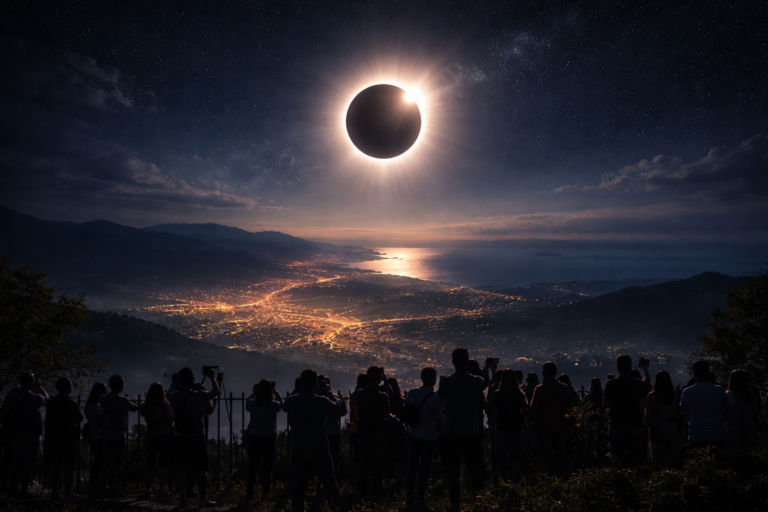
The sky will dramatically transform as day turns into night during one of the most extraordinary celestial events of our time — the longest total solar eclipse of the century. Expected to occur on August 2, 2027, this rare astronomical phenomenon will plunge large parts of Earth into darkness for over 6 minutes, making it the longest eclipse visible from land in more than 100 years.
This event is already generating global excitement among scientists, travelers, and skywatchers as it promises a once-in-a-lifetime spectacle.
What Is A Total Solar Eclipse?
A total solar eclipse happens when the Moon passes directly between the Earth and the Sun, completely blocking sunlight and casting a shadow on Earth. During this brief period called totality, the sky darkens, stars become visible, and temperatures drop noticeably.
Key highlights of totality include:
- The Sun’s glowing outer layer (corona) becomes visible
- Sudden darkness in daytime
- Unusual animal behavior
- Sharp drop in temperature
Why This Eclipse Is Called The Longest Of The Century
The August 2, 2027 eclipse stands out because of its extraordinary duration — up to 6 minutes and 23 seconds at peak locations.
Key Scientific Reasons
- The Moon will be near perigee (closest to Earth), appearing larger
- The Earth will be near aphelion (farther from the Sun), making the Sun appear smaller
- The alignment allows the Moon to cover the Sun for a longer time
This rare combination leads to an extended and deeply immersive totality phase, unlike shorter eclipses that typically last 2–4 minutes.
Where Will The Eclipse Be Visible?
The eclipse will sweep across multiple continents, creating a path of totality — a narrow band where full darkness occurs.
Regions Experiencing Totality
- Southern Europe (including parts of Spain)
- North Africa (Morocco, Algeria, Tunisia, Egypt)
- Middle East (Saudi Arabia, Yemen)
- Parts of East Africa
Millions of people will witness complete darkness, while billions will experience a partial eclipse across surrounding regions.
Table: Key Facts About The Longest Solar Eclipse Of The Century
| Feature | Details |
|---|---|
| Date | August 2, 2027 |
| Type | Total Solar Eclipse |
| Maximum Duration | Up to 6 minutes 23 seconds |
| Visibility Path | Europe, North Africa, Middle East |
| Best Viewing Locations | Egypt (Luxor), Morocco, Saudi Arabia |
| Scientific Significance | Rare orbital alignment |
| Next Similar Event | After 2100 |
Upcoming Build-Up: The 2026 Eclipse Before The Main Event
Before the 2027 spectacle, another important total solar eclipse will occur on August 12, 2026.
Highlights Of The 2026 Eclipse
- Duration: Around 2 minutes 18 seconds at maximum
- Visible in: Greenland, Iceland, northern Spain
- First major eclipse in mainland Europe since 1999
This event acts as a precursor, marking the beginning of what astronomers call a “golden age of eclipses.”
What Happens During Totality?
During the peak moment of the eclipse, the transformation is dramatic:
- Bright daylight fades into twilight
- Stars and planets become visible
- The Sun’s corona glows around a black disk
- Shadows disappear or become distorted
- Birds may stop singing and animals behave unusually
This surreal shift creates an unforgettable experience often described as otherworldly.
Safety Tips For Viewing The Eclipse
Viewing a solar eclipse requires proper precautions:
- Use ISO-certified solar viewing glasses
- Avoid looking directly at the Sun without protection
- Use pinhole projectors or solar filters
- Only remove eye protection during totality
Improper viewing can cause permanent eye damage, making safety essential.
Scientific And Economic Impact
Scientific Importance
- Study of the Sun’s corona and solar winds
- Data collection on atmospheric changes
- Improved understanding of celestial mechanics
Economic Boost
- Massive tourism in viewing zones
- Hotel bookings and travel demand surge
- Local economies benefit from global visitors
Past eclipses have generated billions in economic activity, and 2027 is expected to surpass previous records.
Future Of Solar Eclipses
Solar eclipses occur somewhere on Earth every 18 months, but total eclipses at a specific location are rare — often once every 300–400 years.
The 2026–2028 period is particularly unique, featuring multiple major eclipses, making it a historic era for astronomy enthusiasts.
Conclusion
The longest total solar eclipse of the century in 2027 is far more than a celestial event — it is a global phenomenon that will unite millions under a shared sky. As daylight fades into darkness for over six minutes, people across continents will witness one of nature’s most powerful displays. Combined with the 2026 eclipse leading up to it, this period marks a rare opportunity to experience cosmic precision at its finest. Whether you are a scientist, traveler, or casual observer, preparing early for this event could reward you with a once-in-a-lifetime memory that will not be repeated for generations.