
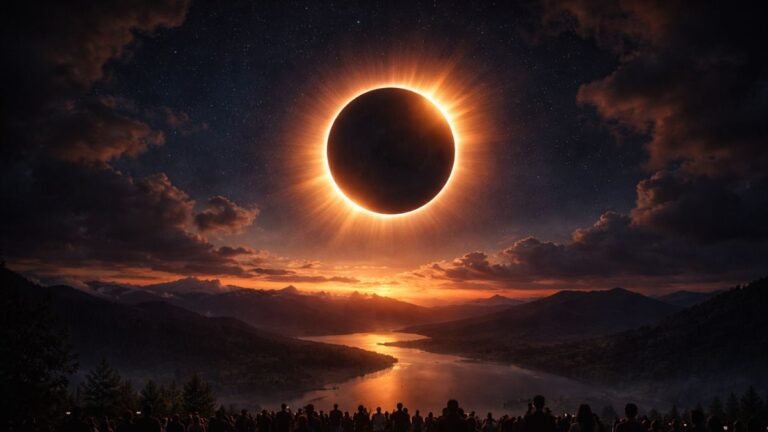
A rare celestial event is poised to captivate skywatchers worldwide: day will turn to night as the longest total solar eclipse of the century sweeps across parts of the globe. For a narrow band of observers who find themselves inside the path of totality, the Sun will be completely obscured by the Moon, plunging daytime into an uncanny twilight and revealing the Sun’s ethereal corona.
What to expect during totality
Total solar eclipses are more than a simple blocking of light. Observers can expect a sequence of dramatic phenomena:
- Partial phases as the Moon gradually covers the Sun
- Baily’s beads and the diamond ring effect just before and after totality
- The corona: the Sun’s glowing outer atmosphere visible without special filters
- Sudden temperature drop and a change in ambient light and color
- Stars and planets becoming visible in the daytime sky
- Unusual animal and human behavior as light and temperature shift
Because this eclipse is poised to be the longest of the century, those fortunate enough to stand in the centerline during totality will experience these moments for a longer stretch of time, making the spectacle even more memorable.
Where and when to watch
The eclipse will sweep across parts of the globe in a narrow path known as the path of totality. Outside that path, observers will see a partial eclipse: the Sun appears as a crescent rather than being fully obscured. If you plan to watch, do these three things:
- Check an authoritative eclipse map or site (NASA, local astronomical societies) for the exact path and timing.
- Note the local weather forecast; clear skies are essential for viewing.
- Plan travel and lodging well in advance if you intend to position yourself in the path of totality — popular viewing locations fill up rapidly.
Always confirm local start and end times for partial phases and totality, and be aware that totality may last several minutes at maximum — significantly longer than many more common eclipses.
Safety: protect your eyes
Never look directly at the Sun without proper eye protection except during the brief period of totality when the Sun is completely covered. To view the partial phases, use:
- ISO-certified solar eclipse glasses (not regular sunglasses)
- Solar filters for binoculars, telescopes, and cameras (mounted securely)
- Pinhole projectors or indirect viewing methods for safe observation
Remember: viewing the Sun without proper protection can cause permanent eye damage. Do not remove filters when looking through cameras or binoculars unless a certified solar filter is in place.
Photographing the eclipse
Photographing an eclipse is rewarding but challenging. Tips for better results:
- Scout a location with a clear horizon and minimal light pollution.
- Use a tripod for steady shots and a remote shutter release to avoid shake.
- For partial phases, use a solar filter on your lens; remove it only during totality.
- Bracket exposures during totality to capture the corona’s range of brightness.
- Practice framing and camera settings before the event to avoid missing critical moments.
Join local astronomy clubs or social media groups for hands-on help and potential group photo projects.
Experience and etiquette
Eclipses draw communities together. Consider attending public viewing events hosted by observatories or universities. When traveling to view the eclipse:
- Arrive early to avoid crowds and traffic.
- Respect private property and local communities.
- Minimize environmental impact: take only pictures, leave only footprints.
- Share the moment — many eclipse-watchers describe the experience as both personal and communal, with spontaneous applause and quiet awe when totality begins.
After the eclipse
The excitement doesn’t end when the Sun re-emerges. Expect lively discussion, shared photos, and a boost to local tourism in viewing regions. Scientists will also analyze observations collected from different points along the path to learn more about the Sun’s corona and atmospheric effects.
Whether you are a lifelong amateur astronomer or a curious first-time observer, this event is a rare chance to witness a dramatic, beautiful intersection of celestial mechanics and human wonder. If possible, position yourself within the path of totality and prepare — when day turns to night during the longest total solar eclipse of the century, it will be a sight to remember.