
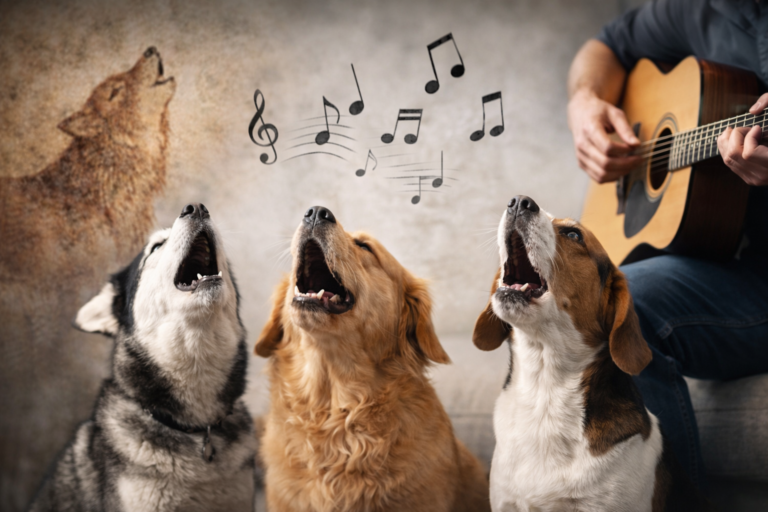
If you’ve ever played a song and noticed your dog suddenly howling along, you might assume the sound is irritating them. However, science suggests something far more fascinating. This behavior is not about discomfort—it’s rooted in ancient evolutionary instincts, communication patterns, and even emotional responses.
Understanding why dogs howl at music reveals a deep connection between modern pets and their wild ancestors, offering insight into canine behavior, communication, and auditory sensitivity.
What Is Howling? A Natural Canine Language
Howling is a long, sustained vocalization used by many members of the canine family, including wolves, coyotes, and domestic dogs.
Unlike barking, which is short and repetitive, howling serves as a long-distance communication tool. In the wild, wolves use howls to:
- Locate pack members
- Signal territory boundaries
- Coordinate group activities
- Strengthen social bonds
Dogs, being descendants of wolves, have retained this instinct even in domestic environments.
The Ancient Evolutionary Cause Behind Howling at Music
The primary reason dogs howl at music lies in their evolutionary heritage.
- Dogs evolved from pack-living wolves that relied on howling to communicate.
- Musical sounds—especially high-pitched or sustained tones—can mimic the frequency and structure of a wolf’s howl.
- When dogs hear such sounds, their brains interpret them as a social signal, triggering a response.
This means your dog isn’t annoyed—they are essentially “joining the chorus” as part of an instinctive pack response.
How Music Triggers the Howling Response
Sound Frequencies And Sensitivity
Dogs have far superior hearing compared to humans.
- Humans hear up to ~20,000 Hz
- Dogs can detect frequencies between 45,000–67,000 Hz
This allows them to pick up subtle tones in music that resemble canine vocalizations.
Pitch Matching Ability
Recent studies show that some dogs can even adjust their pitch when howling along with music.
This suggests that dogs are not just reacting—they are actively synchronizing with the sound, similar to primitive musical behavior.
Emotional And Social Factors Behind Howling
Emotional Contagion
Dogs are highly sensitive to emotional cues. Music can trigger an emotional resonance, leading them to vocalize.
As experts explain, dogs may howl because they “feel” the music and respond emotionally.
Pack Bonding Behavior
Howling is also a social bonding mechanism.
- In the wild, wolves howl together to strengthen unity
- Domestic dogs may howl to bond with their owners or other dogs
This explains why dogs often howl when humans sing or when multiple dogs are present.
Is Howling a Sign of Distress?
Contrary to popular belief, howling at music usually does not indicate discomfort or pain.
Dogs may howl due to:
- Instinctive communication
- Excitement or engagement
- Social participation
Experts note that if a dog shows no signs of stress—such as shaking, hiding, or excessive panting—the behavior is completely normal.
Why Some Dogs Howl More Than Others
Not all dogs react the same way to music.
Breed Differences
- Ancient breeds like Huskies and Malamutes are more likely to howl
- Modern breeds may prefer barking instead
Genetic Influence
Dogs closer to wolves genetically retain stronger howling instincts, while others have lost some of these behaviors over time.
Table: Key Scientific Reasons Dogs Howl at Music
| Factor | Explanation | Scientific Insight |
|---|---|---|
| Evolutionary Instinct | Inherited from wolves | Used for communication and bonding |
| Sound Frequency | Music mimics howling tones | Dogs hear higher frequencies than humans |
| Pitch Recognition | Dogs adjust their vocal pitch | Indicates primitive vocal learning |
| Emotional Response | Music triggers emotional reactions | Known as emotional contagion |
| Social Behavior | Dogs “join in” like a pack | Reinforces group connection |
| Breed Genetics | Some breeds howl more | Closer genetic link to wolves |
The Role of Contagious Howling
One interesting phenomenon is contagious howling.
- When one dog howls, others often join in
- Music can act as the “first howl” trigger
This domino effect mirrors wolf pack behavior, where coordinated howling strengthens communication and identity.
Does Music Type Matter?
Yes, the type of music can influence how dogs respond.
- High-pitched instruments (violin, flute) often trigger howling
- Sustained tones resemble canine vocal patterns
- Some dogs respond more to singing voices than instruments
Interestingly, calmer music like classical tunes may relax dogs instead of triggering howling.
Future Scientific Insights
Emerging research suggests that canine vocal behavior could provide clues about:
- The evolution of communication in mammals
- Early forms of musical perception
- The origins of group vocal coordination
Scientists now believe that howling behavior may predate complex vocal learning seen in humans.
This opens exciting possibilities for understanding both animal cognition and human evolution.
Conclusion
Dogs howl at music not because it bothers them, but because it awakens an ancient instinct deeply embedded in their DNA. This behavior reflects a blend of evolution, communication, emotional sensitivity, and social bonding.
Far from being a nuisance, your dog’s musical howling is a reminder of their wild ancestry—a living echo of wolves communicating across vast landscapes.
So the next time your dog joins your playlist, think of it not as noise—but as a timeless duet between species.