
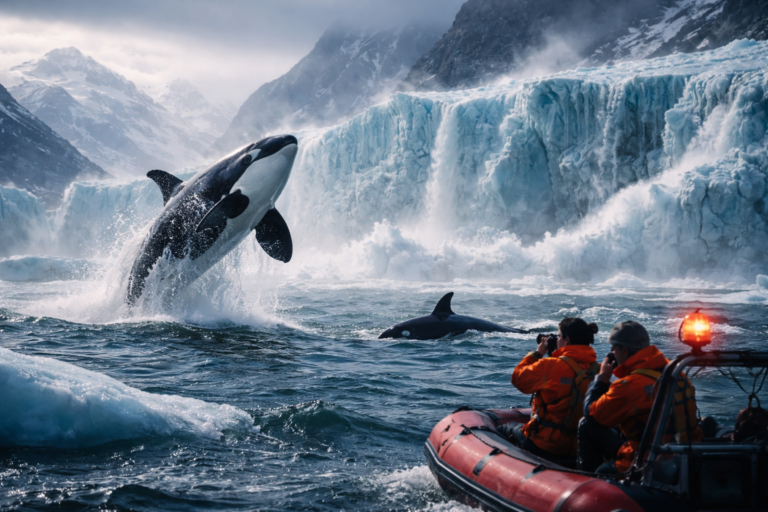
Scientists and local authorities have declared an emergency in parts of Greenland after researchers observed orcas breaching and hunting right at the edges of ice shelves that are already retreating faster than expected. The striking images and field reports have raised alarm about the changing behavior of marine predators, immediate risks to coastal communities and wildlife, and the accelerating impacts of climate change on Arctic ice dynamics.
What researchers are seeing
Field teams working along Greenland’s western and northern coasts report multiple encounters with orca pods moving into areas that used to be covered by stable fast ice. Researchers documented:
- Orcas breaching and swimming within meters of calving ice fronts.
- Increased predation on seals that use broken ice floes as haul-out sites.
- Novel hunting strategies adapted to patchy, melting ice habitats.
These behaviors are notable both for their boldness and for the context: ice shelves and adjacent pack ice are fragmenting earlier in the season and more extensively than historical records suggest.
Why this matters
The observations matter on several levels:
- Ecological disruption: Seals and other ice-dependent species rely on stable ice for resting, molting, and raising pups. As orcas exploit newly open water and fragmented floes, seal mortality and stress levels could spike, cascading through the food web.
- Human safety: Coastal communities that depend on sea ice for travel, hunting, and safety are now facing unpredictable ice conditions and larger predators closer to shore.
- Ice shelf stability: Orca proximity to ice fronts can accelerate calving events by disturbing weakened ice, although the primary drivers of melting remain warming ocean and air temperatures.
- Indicator of climate change: The shift in predator behavior underscores the rapid pace of environmental change in the Arctic and the complex, sometimes unexpected consequences.
Drivers behind the change
Researchers caution that orca behavior is likely a response to multiple converging factors:
- Warmer ocean temperatures that reduce sea ice extent and create open-water corridors.
- Changes in prey distribution as fish and seal populations move in response to altered ice and temperature regimes.
- Increased human activity and noise that displace prey and push predators to new hunting grounds.
While the presence of orcas near melting ice shelves is dramatic, scientists emphasize that climate-driven habitat loss remains the underlying issue.
What authorities are doing
In response to the emergency declaration, Greenlandic officials, in coordination with international research partners, have started several measures:
- Enhanced monitoring: Deploying aerial surveys, satellite imagery, and acoustic sensors to track ice conditions and orca movements in real time.
- Public advisories: Issuing guidance for coastal communities about avoiding ice edges, recognizing signs of predator presence, and maintaining safe distances from wildlife.
- Research mobilization: Increasing funding and logistics support for teams studying the interplay between ice melt and marine predator behavior.
- Emergency preparedness: Preparing search-and-rescue assets and contingency plans for community evacuations or urgent wildlife response actions if needed.
What can be done next
Addressing this situation requires both immediate and long-term steps:
Short-term actions
- Improve real-time communication to coastal residents and researchers.
- Establish no-go buffer zones near unstable ice fronts.
- Increase resources for wildlife rescue and rehabilitation where feasible.
Long-term strategies
- Accelerate global efforts to reduce greenhouse gas emissions to slow Arctic warming.
- Expand long-term ecological monitoring to understand changing predator-prey dynamics.
- Support community adaptation planning that integrates traditional knowledge with scientific data.
- Strengthen international cooperation on Arctic conservation and emergency response.
Final thoughts
The emergency declared in Greenland as researchers spot orcas breaching dangerously close to rapidly melting ice shelves is a vivid reminder that climate change is reshaping ecosystems in visible, sometimes dramatic ways. The images and field reports are not just a call to protect wildlife and local communities in the immediate term; they are a signal that broader, sustained action is needed to address the root causes of Arctic transformation. Concerted monitoring, local preparedness, and global climate mitigation together offer the most realistic pathway to reduce risks and preserve fragile polar environments for future generations.