
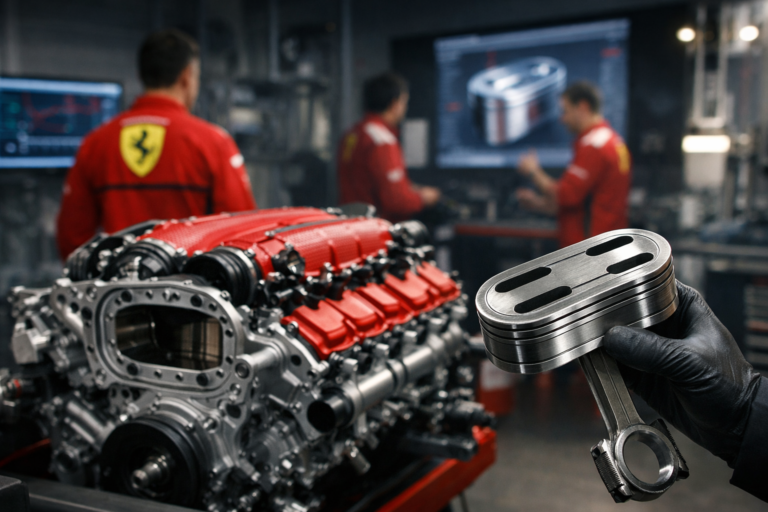
Ferrari has pulled back the curtain on a radical rethinking of the internal combustion engine: oblong piston technology. Engineers describe the change as more than a cosmetic tweak — it’s an unexpected redesign that could reshape engine performance far beyond what current models achieve.
This announcement signals a shift in how engineers approach combustion dynamics, mechanical efficiency, and packaging. Below, we break down what oblong piston technology is, why it matters, and what it could mean for road cars and motorsport.
What is oblong piston technology?
Traditional pistons are cylindrical and move vertically within a round bore. Oblong piston technology replaces that circular cross-section with an elongated, oval-like shape and changes the motion path inside a correspondingly shaped sleeve.
The oval geometry alters several key engine attributes:
- It modifies the effective stroke and piston surface area.
- It changes piston ring dynamics and sealing behavior.
- It affects how the combustion chamber evolves during compression and expansion.
Engineers involved in the project say this unexpected redesign was driven by a desire to extract greater thermal efficiency and better control over combustion.
Why Ferrari pursued this redesign
According to Ferrari engineers, oblong piston technology offers potential advantages that address long-standing trade-offs in engine design. The main goals were:
- Improve volumetric efficiency across a wider rev range.
- Reduce frictional losses by optimizing piston-to-wall contact.
- Tailor combustion chamber shape to encourage cleaner, faster burn.
Ferrari’s team emphasizes that the redesign was not intended merely to chase peak horsepower. Instead, it aims to reshape how the engine breathes and converts fuel into usable power and torque across the entire operating range.
Key potential benefits
Oblong pistons bring several promising benefits that could influence both performance and efficiency:
- Better control of combustion chamber geometry: A non-circular piston changes the space where the air-fuel mixture burns, potentially improving swirl and turbulence for faster, cleaner combustion.
- Broader torque band: By altering the effective stroke dynamics, engines may sustain higher volumetric efficiency at lower and higher rpm, translating to stronger midrange torque without sacrificing top-end power.
- Reduced friction and wear: Reconfiguring contact angles and ring placement may lower lateral forces on the piston skirt, cutting friction and improving longevity.
- Packaging flexibility: An oblong arrangement could allow designers to tweak bore spacing and block dimensions in ways that benefit engine packaging, center of gravity, or hybrid integration.
Engineering challenges and trade-offs
No breakthrough comes without trade-offs. Ferrari’s engineers acknowledge several hurdles:
- Manufacturing complexity: Producing oval cylinders, specially shaped pistons, and compatible rings requires new machining and quality-control methods.
- Lubrication and sealing: The altered geometry changes how oil is distributed and how rings seal, requiring new solutions to prevent blow-by and uneven wear.
- Thermal stresses: Different wall thicknesses and shapes can create non-uniform thermal expansion, demanding refined materials and cooling strategies.
- Cost and scalability: Initially, complexity will drive up costs, limiting near-term application to high-end or racing models before wider adoption.
Where this could be applied
Engineers say the initial rollout will likely focus on limited-production performance models and motorsport, where performance gains justify development costs. Longer-term, oblong piston technology could influence:
- High-performance road cars seeking improved throttle response and broader torque.
- Hybrid powertrains where compact, high-efficiency combustion units run as range extenders.
- Motorsport classes where regulation allows geometric innovation and rewards efficiency.
What this means for the future of engines
If Ferrari’s engineers are correct, oblong piston technology may represent one of the most significant mechanical innovations in modern engine design. It’s an approach that reframes the geometry of motion inside the most fundamental part of the engine, with ripple effects across combustion, emissions, and mechanical efficiency.
Adoption will depend on solving production challenges and proving durability under real-world conditions. But if successful, this unexpected redesign could push internal combustion further into an era of higher efficiency and smarter packaging — keeping performance engines relevant even as the automotive landscape rapidly electrifies.
Only time will tell whether oblong piston technology becomes a niche innovation or a new standard. For now, it’s a bold reminder that even century-old technologies can be reinvented with fresh thinking and a willingness to challenge the circle.