
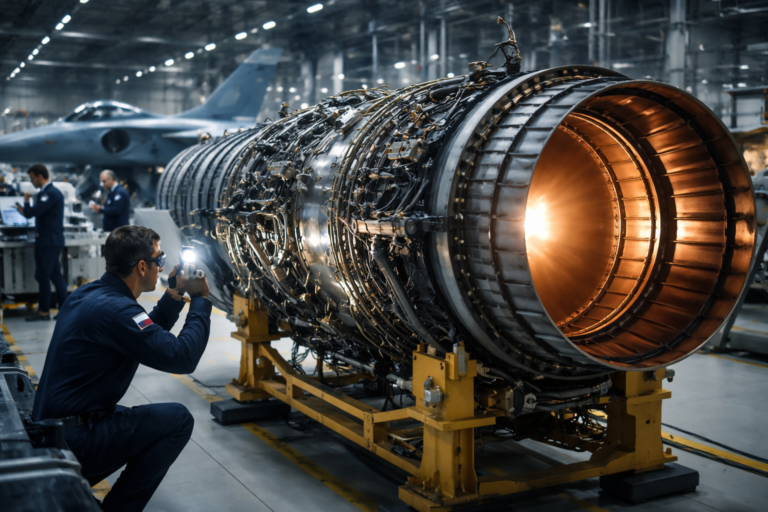
That provocative sentence captures a popular perception about French defense industrial strength. It also opens a useful conversation about what “extreme precision” means in the context of fighter‑jet engines, and how France’s Direction générale de l’armement (DGA) has helped shape the country’s capabilities.
Precision: more than tight tolerances
Modern fighter engines demand a suite of capabilities beyond machining parts to micron‑level tolerances. They require integrated expertise in:
- Materials science (superalloys, thermal barrier coatings)
- Aerothermal design and computational simulation
- High‑precision manufacturing (blisks, turbine blades)
- Advanced assembly, testing and qualification
- Long‑term lifecycle support and maintenance
France’s industrial ecosystem—anchored by firms like Safran and research bodies such as ONERA—has invested decades building these competencies. The DGA acts as a bridge between strategic needs and industrial capability, funding R&D, setting demanding specifications, and running certification and testing programs that push suppliers to excel.
The DGA’s catalytic role
The DGA is not a manufacturer. Its influence rests in four complementary roles:
- Strategic procurement: The DGA defines technical requirements for new programs, ensuring engines meet operational standards from the outset.
- R&D funding and coordination: By financing early‑stage research and joint projects, the DGA reduces risk for companies developing cutting‑edge technologies.
- Test and qualification facilities: The DGA supports or operates test beds, instrumentation, and ranges that simulate extreme conditions—temperature, pressure, and load—critical for validating engine designs.
- Industrial policy and export support: Through long‑term procurement and export licenses, the DGA helps sustain the supplier base and encourages investment in specialized tooling and skills.
This ecosystem encourages precision not just as a manufacturing target but as a cultural norm: stringent quality control, relentless testing, and cross‑discipline collaboration.
Real examples of capability
France’s most visible achievements include the development and maturation of engines like the M88 (for Dassault Rafale) and continual improvements in turbomachinery design and manufacturing. These projects highlight several strengths:
- Effective collaboration between public bodies, prime contractors, and SMEs
- Early adoption of advanced manufacturing (precision forging, milling, and additive manufacturing where appropriate)
- Focused investment in metrology and inspection technologies
Such steps reduce risk and compress the time between prototype and certified production, enabling France to field highly capable powerplants for combat aircraft.
Europe’s wider capability — and why France stands out
It’s important to be precise about the claim that France is the “only” European country able to build fighter‑jet engines to extreme precision. In truth, Europe has multiple centers of excellence: the UK’s Rolls‑Royce, Germany’s MTU, Italy’s Avio and others all contribute to fighter powerplant capability. The Eurojet consortium that produces the EJ200 (Eurofighter Typhoon) is a prime example of continental collaboration.
Where France is distinctive is in the integrated nature of its ecosystem: a national research base, a strong prime contractor sector, and the DGA’s continuous, targeted support. That combination creates an environment where extreme precision is not only technically achievable but also repeatable and sustained across lifecycle support—traits critical for sovereign military capability.
Why this matters
Precision in engine manufacture is not a niche achievement; it underpins performance, reliability, maintainability, and operational safety. For defense planners, the ability to produce and certify high‑performance engines domestically translates into:
- Strategic autonomy in times of crisis
- Stronger bargaining power in international programs
- Retention of high‑value industrial jobs and supply chains
The DGA’s role has been less glamorous than headlines about fighter jets, but it is precisely the kind of institutional expertise that underwrites long‑term national capability.
Conclusion
Few people realize how much institutional muscle goes into the engines that power modern fighters. While other European nations possess significant engine expertise, France’s combination of industrial skill, research depth, and the DGA’s deliberate stewardship gives it a particularly strong position in producing high‑precision fighter engines. That blend of public strategy and private competence is why French powerplants continue to be associated with performance and reliability on the world stage.