
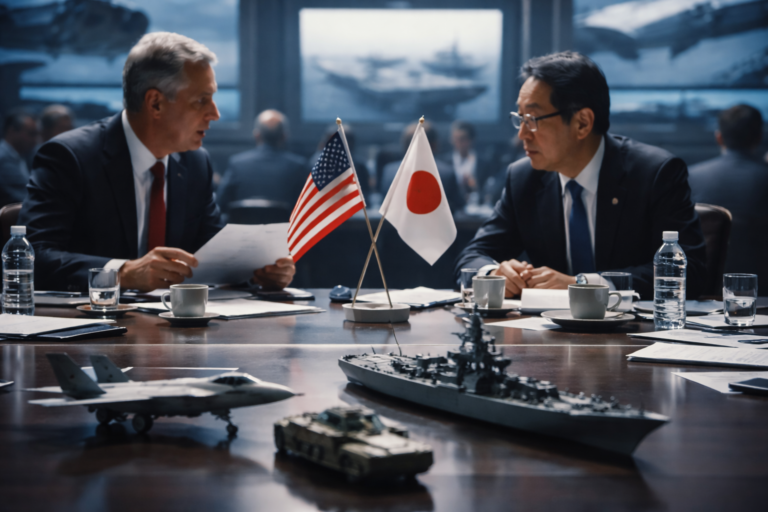
Japan’s rapid post-2022 defence pivot has been one of the defining geopolitical shifts in East Asia. But as Tokyo tries to move from a decades-long reliance on U.S. suppliers toward greater self-reliance, it’s encountering a blunt truth: many U.S. defence contracts are structured so that “heads I win, tails you lose.” That blunt phrase captures how procurement rules, intellectual property regimes, and industrial incentives can leave buyers — even close allies — locked into expensive, asymmetric relationships.
How the game works
American defence firms and procurement systems use several levers that advantage U.S. suppliers and keep foreign buyers dependent:
- Restricted technology transfer. ITAR and other export controls limit what software, source code, and sensitive subsystems can be shared. That makes in-country sustainment and modification costly or impossible without U.S. approval.
- Complex licensing and IP terms. Contracts often retain crucial intellectual property with the U.S. firm, meaning the buyer pays again and again for upgrades, spares, and support.
- FMS and pricing opacity. The U.S. Foreign Military Sales (FMS) process can offer security guarantees and financing, but it can also obscure unit costs, add service fees, and limit direct negotiation.
- Supplier concentration. Key platforms have a small number of prime contractors; lack of competition raises prices and reduces leverage.
- Aftermarket capture. The real profit often comes from spare parts, maintenance, and upgrades — areas where sellers retain control and margin.
For Japan, that has meant deals that look attractive at signing but become costly and constraining over a 10- to 20-year lifecycle.
Case studies Japan knows well
The F-35 program is a clear cautionary tale. Japan is a partner and purchaser of the F-35, with domestic assembly and maintenance roles. Yet it has faced challenges over spare-parts availability, opaque pricing for sustainment, and restricted access to certain software elements. Similar dynamics have arisen in naval systems and missile technologies where key modules remain U.S.-controlled.
These problems aren’t always intentional malice — they emerge from legal frameworks, corporate incentive structures, and national-security caution. Still, the cumulative effect is predictable: the buyer pays more, gets less control, and faces long-term dependence.
Why Japan is waking up (even if late)
Several factors nudged Tokyo into reassessment:
- Strategic necessity. China’s military rise and DPRK provocations forced Japan to increase defence spending and to want independence in sustainment and production.
- Budget realism. Modern platforms are expensive to operate; lifecycle costs can dwarf acquisition prices.
- Industrial policy ambitions. Japan wants to rebuild a sovereign defence-industrial base and capture high-value jobs and technologies.
- Alliance friction. Tokyo increasingly seeks parity in bargaining leverage with Washington rather than being content as a perennial customer.
Realizing the mismatch between ambition and procurement reality is the first step. Acting on it is harder.
What Japan should demand now
To break the “heads I win, tails you lose” dynamic, Tokyo can pursue several practical measures:
- Push for genuine tech transfer. Make IP sharing, source-code access, and local production non-negotiable parts of future contracts.
- Use competition and offsets. Require transfer of skills and supply-chain development as contract conditions, and invite third-country suppliers where strategic.
- Build a sovereign sustainment capability. Invest in domestic MRO (maintenance, repair, overhaul) facilities and software expertise to reduce aftermarket dependence.
- Reassess procurement vehicles. Evaluate direct commercial sales versus FMS and consider blended financing to improve transparency.
- Forge co-development deals. Joint development positions Japan as a partner with shared risk and rewards, not just a customer.
What the alliance can look like
This isn’t about rupturing the U.S.–Japan alliance. A mature partnership can be win-win: U.S. firms gain a reliable partner and industrial base support, while Japan secures technology, jobs, and strategic autonomy. The trick is to write contracts and shape policy so benefits are shared fairly.
Tokyo’s awakening may be belated, but it’s timely. As Japan sharpens its procurement strategy, the old “heads I win, tails you lose” setup can be replaced by arrangements that strengthen both national defence and the alliance — provided Tokyo presses hard for real access, transparency, and co-ownership of its future capabilities.