
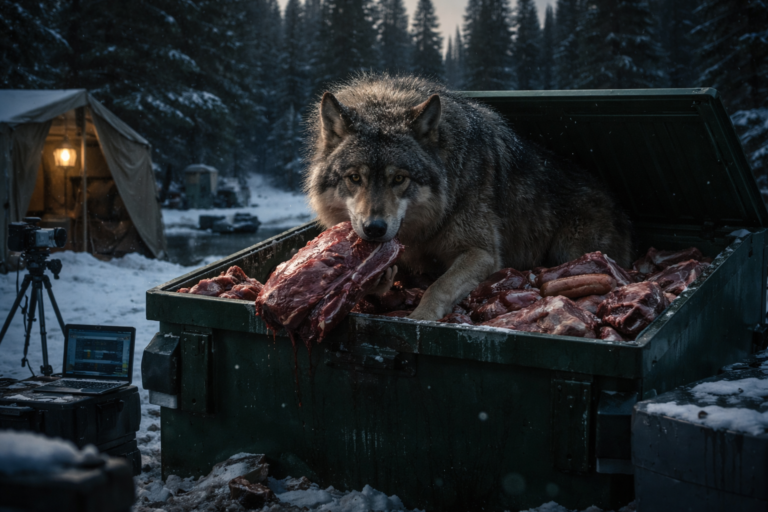
On a cold morning in northern Canada, researchers arrived at a field site to find a tableau that looked more like a staged heist than a moment in the wilderness. Equipment disrupted, bait missing, and only a single set of tracks leading away. At the center of it all: a wolf that had exploited a series of clever human contraptions to reach an easy meal. The scene left wildlife biologists and the local community both bemused and awestruck.
The scene: unlikely cunning in the snow
What made the incident so striking was the combination of planning and persistence on display. The research team had taken what they considered robust precautions: locked coolers, elevated bait stations, and motion-triggered cameras. Yet the wolf bypassed several layers of protection to reach a stash of meat intended for a long-term study.
Eyewitnesses and camera footage (when available) described:
- Nudging and prying at latches rather than brute force.
- Manipulating ropes and levers to dislodge barriers.
- Returning repeatedly over several nights, seemingly learning from failed attempts.
It wasn’t the first time wolves had scavenged human food, but the methodical, adaptive behavior captured on camera suggested something beyond opportunism: problem-solving.
Why scientists were left speechless
Biologists did not expect to see such apparent innovation from a single wolf. Wolves are, of course, intelligent social predators with complex behaviors, but this episode revealed cognitive flexibility that surprised even experienced researchers. Several things contributed to the astonishment:
- The animal appeared to learn from failed attempts and modify its approach.
- Some actions resembled tool-like manipulation—not typical for canids in human-dominated settings.
- The persistence and timing suggested the wolf anticipated when humans would be absent.
Scientists emphasize caution in interpretation: one clever wolf does not rewrite decades of behavioral research. Still, the event prompted lively discussion about the cognitive capacities of wolves, their adaptability, and how human environments create new problem-solving challenges for wildlife.
Possible explanations: curiosity, necessity, and opportunity
Experts offered several hypotheses that together help explain the wolf’s behavior:
- Adaptive learning: Wolves, like many carnivores, can learn through trial and error. Repeated exposure to human structures and food can accelerate this learning.
- High motivation: Scarcity of natural prey or winter energy demands can drive animals to take greater risks and expend more effort for calorie-rich rewards.
- Individual temperament: Just as with humans, individual animals vary. A particularly bold, curious wolf might push boundaries others would avoid.
- Social knowledge transfer: If one wolf masters a technique, pack members can observe and adopt it, spreading the behavior.
These explanations highlight how wildlife cognition and ecological pressure interact. Human ingenuity—designed to protect resources—can unintentionally become a puzzle that stimulates animal ingenuity in return.
Broader implications for conservation and coexistence
This incident is more than an entertaining anecdote. It raises practical and ethical questions about human-wildlife coexistence:
- Management strategies need to anticipate behavioral adaptation. Locks and barriers may be only short-term solutions if animals learn to defeat them.
- Preventing food conditioning is crucial. Easy access to human food can alter animal behavior, increasing conflict and risk for both people and wildlife.
- Research protocols should minimize attractants and consider how equipment might be manipulated by animals.
- Public education matters: understanding wildlife motivations reduces fear and promotes sensible measures like secure storage and proper waste management.
What we can learn from a clever wolf
The surreal image of a wolf outsmarting human contraptions is a reminder of nature’s capacity to surprise us. Intelligence in wild animals often shows up in small, context-driven ways. Observing and respecting that intelligence shifts how we design our spaces and manage resources.
Rather than framing the incident as a failure of human engineering, it’s useful to see it as an invitation: to improve how we live alongside adaptable wildlife, to refine research practices, and to appreciate the cognitive lives of animals we share the land with. In a rapidly changing world, flexibility and humility may be the best tools humans have when dealing with the ingenuity of the wild.