
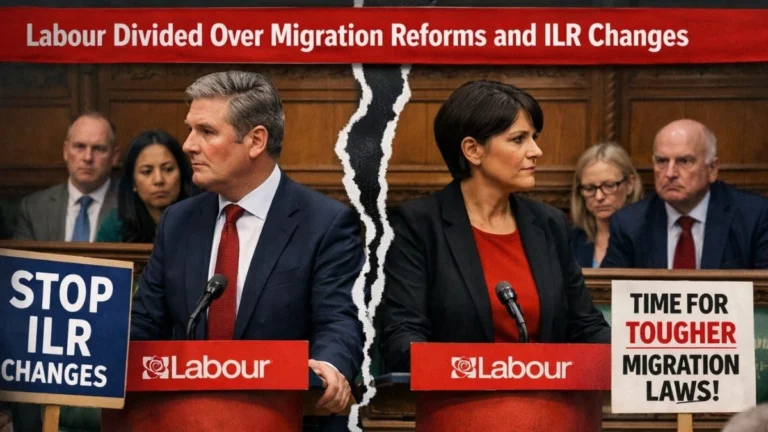
A group of Labour MPs is preparing to publicly demonstrate their opposition to the government’s proposed immigration reforms by pushing for a symbolic parliamentary vote. This move could expose internal disagreements within the party if ministers refuse to reconsider the plans.
The proposed reforms, led by Home Secretary Shabana Mahmood, have sparked significant debate, particularly around changes to indefinite leave to remain (ILR)—commonly referred to as permanent residency in the UK.
Key Proposal: Doubling Wait Time for Permanent Residency
At the center of the controversy is a proposal to extend the waiting period for migrants seeking ILR. Under current rules, most migrants can apply after five years, but the government plans to increase this to 10 years in most cases.
This change would affect a wide range of individuals, including:
- Care workers
- Refugees
- Other long-term migrants already living in the UK
Settlement status allows individuals to live, work, and study indefinitely, and in some cases access benefits if eligible.
Government Position: Reform Without Parliamentary Vote
The Home Office has stated that these reforms do not require new legislation, meaning they can be implemented without a formal vote in Parliament.
However, critics are exploring procedural options to force a non-binding vote, aiming to highlight opposition and put pressure on the government to reconsider.
Although such a vote would not legally stop the reforms, it could politically embarrass ministers by exposing divisions within Labour.
Migration Figures Driving Policy Changes
The government has justified the reforms using recent migration data:
- Net migration increased the UK population by 2.6 million between 2021 and 2024
- Around 1.6 million people are expected to gain settlement between 2026 and 2030
Officials argue that tightening settlement rules is necessary to maintain public confidence and manage migration levels.
Influence of International Policies
The reforms are partly inspired by measures adopted by Denmark’s Social Democrats, which the Home Office believes have successfully reduced migration levels.
This international comparison has been used to support the argument for stricter immigration controls in the UK.
Controversy Over Retrospective Application
One of the most contentious aspects of the proposal is its potential application to migrants already residing in the UK, rather than only future arrivals.
This approach has drawn criticism from senior Labour figures, including former deputy leader Angela Rayner, who described it as “un-British”.
Possible Transitional Arrangements Under Consideration
Government sources have suggested the possibility of introducing transitional measures, which could ease the impact for some migrants already in the system.
Despite this, many MPs argue that such adjustments would not address their broader concerns.
Strong Opposition From Labour MPs
Around 100 Labour MPs, led by Folkestone MP Tony Vaughan, have formally expressed opposition to the reforms.
Their concerns include:
- Breaking promises made to migrants already settled in the UK
- Increasing uncertainty for those who relocated based on existing rules
- Ethical concerns about fairness and trust
Some MPs have described their stance as “non-negotiable”, insisting that the proposals should be abandoned entirely rather than modified.
Political Risks and Electoral Pressures
The issue has already surfaced in local politics, including the Gorton and Denton by-election, which Labour recently lost.
While some MPs warn that the reforms could alienate voters, others argue the opposite—that a tougher stance on immigration is necessary to maintain electoral support.
One MP suggested that reversing the policy could cost Labour key seats, particularly in areas where Reform UK is gaining traction.
Mixed Reactions Within and Outside Parliament
Not all Labour MPs oppose the reforms. Some support elements such as new safe and legal migration routes, though they are seeking further details.
Other political parties have taken varying positions:
- Conservatives: Believe the reforms should go further but may support the ILR changes
- Liberal Democrats: Oppose the proposals
- Reform UK: Proposes abolishing ILR entirely if elected
This range of views reflects the broader national debate on immigration policy.
Symbolic Vote Could Highlight Party Divisions
Sources indicate that MPs are considering using rarely invoked parliamentary procedures to force a debate and vote, possibly in both the House of Commons and the House of Lords.
Although any vote would be symbolic and non-binding, it could still carry significant political weight by exposing divisions within Labour on a sensitive issue.
Government Defense of the Reforms
The Home Secretary has consistently defended the changes, arguing they are necessary to:
- Restore trust in the immigration system
- Address the effects of high net migration
- Ensure that permanent residency is earned rather than automatic
A Home Office spokesperson emphasized that the scale of migration in recent years requires a more controlled and structured approach to settlement.
Conclusion
The debate over proposed ILR reforms has revealed deep divisions within the Labour Party, reflecting broader tensions in UK immigration policy. While the government argues that stricter rules are essential to manage migration and maintain public confidence, critics warn of broken promises and unfair treatment of existing migrants.
With MPs preparing to push for a symbolic vote, the issue is set to intensify in the coming months. Whether the government proceeds unchanged or introduces compromises, the outcome will have significant implications for migrants, political dynamics, and public perception of immigration policy in the UK.
FAQs
What is indefinite leave to remain (ILR)?
ILR allows migrants to live, work, and study in the UK permanently and access certain benefits if eligible.
What changes are being proposed to ILR rules?
The government plans to increase the qualifying period from five years to 10 years for most migrants.
Will Parliament vote on these changes?
A vote is not required, but MPs may force a symbolic, non-binding vote to show opposition.