
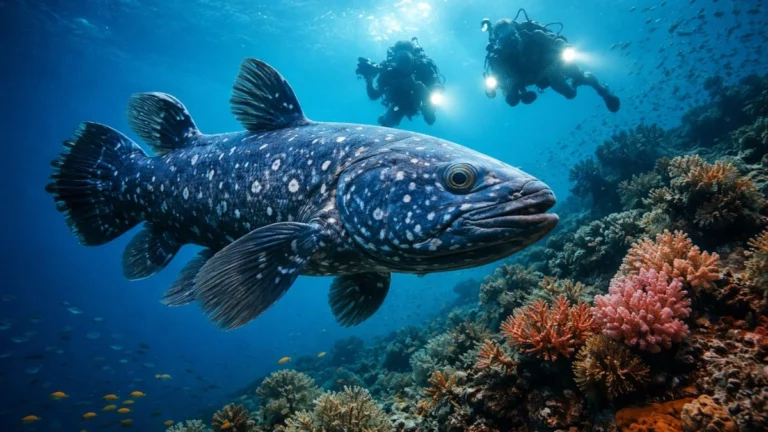
A true living fossil: French divers capture rare first ever images of an emblematic species in Indonesian waters
A team of French divers has reportedly captured what are believed to be the first-ever images of an emblematic “living fossil” species in Indonesian waters. The photographs — taken during a deep-sea expedition off the coast of Sulawesi — have reignited global interest in a creature that bridges the gap between ancient oceans and modern conservation science.
What is a “living fossil”?
The term “living fossil” refers to species that have changed little over millions of years and retain characteristics of their ancient ancestors. These animals are windows into evolutionary history, surviving mass extinctions and dramatic environmental shifts. Their rarity and ancient lineage make them emblematic of biodiversity worth protecting.
In this case, the captured images appear to show a large, slow-moving fish long associated with deep-water habitats and scientific fascination. Its distinctive lobed fins and armored appearance match descriptions of taxa often labeled as living fossils.
The dive and the images
A small French dive team conducted a scientific expedition using mixed-gas rebreathers and remotely operated vehicles (ROVs) to explore a complex underwater canyon system near Indonesian coral reefs. During a night-time descent to depths where sunlight gives way to twilight, the divers and their ROV recorded several clear stills and short video clips.
What makes these images extraordinary is not just the subject, but the context: shallow canyon walls, rich benthic flora, and the presence of other deep-dwelling species were all captured in high resolution. The footage shows:
- The animal’s distinctive lobed fins and thick-scaled body
- Slow, deliberate movement along the substrate
- Behavior suggesting foraging rather than transient passage
- Interactions with the surrounding seafloor community
Scientists are cautious but excited. If confirmed, these images would add a crucial data point to our understanding of the species’ distribution and behavior in Indonesian waters.
Why this discovery matters
Finding — or documenting — such an emblematic species in Indonesian waters has several important implications:
- Biodiversity mapping: Indonesia sits at the heart of the Coral Triangle, a global biodiversity hotspot. Photographic evidence helps fill gaps in species distribution maps.
- Conservation urgency: Rare species often have small, fragmented populations vulnerable to habitat loss, bycatch, and climate change. Visual proof can accelerate protection measures.
- Scientific research: Clear imagery allows researchers to assess morphology, possible injuries, and behaviors without invasive sampling, guiding future studies.
- Public awareness: Compelling photographs galvanize public interest and support for marine conservation in a way that academic papers alone rarely do.
What the images revealed — and what they didn’t
The photographs provide unprecedented visual detail, but they are just one piece of the puzzle. From the images, researchers could identify key morphological traits, estimate size, and observe immediate behavior. However:
- Genetic confirmation is still needed to conclusively identify the species.
- Population numbers and range cannot be determined from single encounters.
- Long-term behavioral patterns require repeated observations.
These images are a starting point, not the final word.
Next steps for researchers and conservationists
To build on this discovery, scientists and conservation organizations are likely to pursue a coordinated response:
- Organize targeted surveys using ROVs, drop cameras, and deep-diving teams.
- Collect environmental DNA (eDNA) samples to confirm species identity non-invasively.
- Engage local communities and fishers to document sightings and reduce harmful interactions.
- Advocate for protective measures in identified habitats, such as no-take zones or fishing restrictions.
How you can help:
- Support reputable marine conservation organizations working in the Coral Triangle.
- Reduce plastic use and chemical runoff that harm coastal ecosystems.
- Promote sustainable seafood choices to lessen pressure on vulnerable species.
A reminder of why the oceans still surprise us
Whether these images turn out to be the first-ever photographic proof or an exciting new record in a long story, they remind us that the ocean still holds secrets. Each new sighting of an ancient lineage deepens our appreciation of life’s resilience and the responsibility we bear to protect it.
As scientists work to verify and study the photographs, the images themselves already perform an invaluable role: they spark curiosity, inspire stewardship, and reaffirm that exploration — even in the 21st century — can yield moments of wonder.