
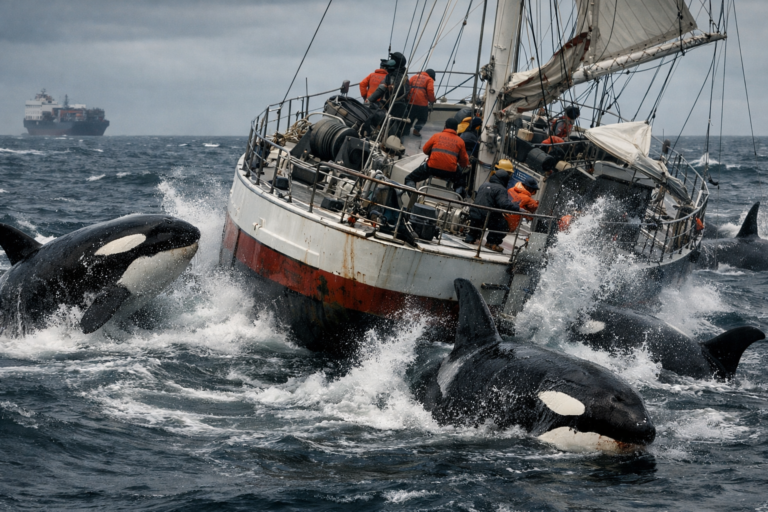
Reports from mariners, marine biologists, and shipping authorities are raising alarms across the region: North Atlantic warning — orcas now targeting commercial vessels in what experts call coordinated assaults. While the full picture is still emerging, multiple accounts suggest a change in behavior among some orca groups that has significant implications for maritime safety and shipping operations.
What’s being reported
Fishermen, cargo crews, and recreational sailors have described encounters where orcas repeatedly approach, ram, or bite the stern and rudder areas of vessels. In several incidents, damage to rudders and propulsion systems has left ships disabled or forced them to divert for repairs.
Observers note that these interactions can involve groups of orcas working together, which some specialists characterize as coordinated behavior rather than isolated curiosity.
Because systematic studies are ongoing, reports vary in detail and certainty. Authorities in affected areas have issued advisories to mariners and are collecting incident reports to better understand patterns of occurrence, timing, and geographic hotspots.
Why might this be happening?
Researchers propose several, non-mutually exclusive explanations:
- Learned behavior and social transmission: Orcas are highly social with strong cultural transmission. A tactic that results in a successful outcome (e.g., getting attention, curbing a perceived threat, or accessing prey) can spread through a pod and between pods over time.
- Mistaken identity or play: Some attacks on propellers and rudders may begin as investigative or play behavior but escalate. Young orcas in particular engage in exploratory biting and nudging.
- Response to predators or threats: Increased ship traffic, naval exercises, or changes in fishing activity might alter orcas’ perception of vessels as threats or rivals.
- Foraging strategies: Changes in prey availability can push orcas to experiment with new tactics. Though no evidence shows orcas eating parts of boats, interactions near gear or fish-processing discharges may be involved.
- Stress and habitat changes: Climate-driven shifts in the distribution of prey and habitat degradation can disrupt typical behaviors and push animals into closer contact with vessels.
Experts stress that current hypotheses require more data. Scientists are calling for coordinated monitoring, acoustic recordings, and tagging studies to determine motive, whether specific pods are involved, and how long this behavior might persist.
Risks and consequences
The consequences extend beyond immediate animal and vessel safety:
- Economic impact: Disabled commercial vessels and diverted routes increase operational costs, insurance claims, and supply-chain delays.
- Safety risks: Mariners face potential hazards if propulsion or steering is compromised at sea, especially in rough weather or high-traffic lanes.
- Conservation and conflict: Escalating encounters can strain public perceptions of marine mammals and complicate conservation outreach, particularly if interventions injure animals or people.
- Research challenges: Rapid changes in behavior demand prompt, rigorous scientific study to inform mitigation without harming cetacean populations.
Practical guidance for mariners
Authorities and marine safety organizations recommend precautionary measures while investigations continue:
- Report sightings and incidents to local maritime authorities immediately and provide GPS location, time, and photographic/video evidence if safe to do so.
- Maintain distance: Reduce speed and avoid approaching pods. Sudden maneuvers or pursuit can provoke interactions.
- Avoid trying to scare or chase animals away; this can escalate behavior.
- Secure rudders and inspect steering systems during routine stops; be prepared for contingency repairs.
- Change course when advised by authorities and consider alternative routing if pods form persistent hotspots.
- Minimize noise and avoid sonar or loud mechanical noises that could disrupt orca communication.
- Brief crews on safety protocols and ensure life-saving equipment is readily accessible.
What scientists and policymakers are doing
Marine researchers are mobilizing to collect observations, acoustic data, and genetic samples to identify which populations are involved and whether behavior is spreading.
Policymakers and port authorities are discussing temporary advisories, speed restrictions, and research-funded response teams to assist disabled vessels and reduce risk.
Collaboration between shipping companies, fishermen, conservation groups, and scientists will be key to producing pragmatic, ethical responses.
Final thoughts
The phrase North Atlantic warning — orcas now targeting commercial vessels in what experts call coordinated assaults — captures a worrying trend that deserves careful attention. While sensational headlines can alarm the public, the most effective response is science-driven and precautionary: document incidents, follow safety guidance, and support research.
Understanding why orcas are changing their interactions with vessels is essential both to protect maritime operations and to ensure the welfare of these intelligent, culturally rich marine mammals.