
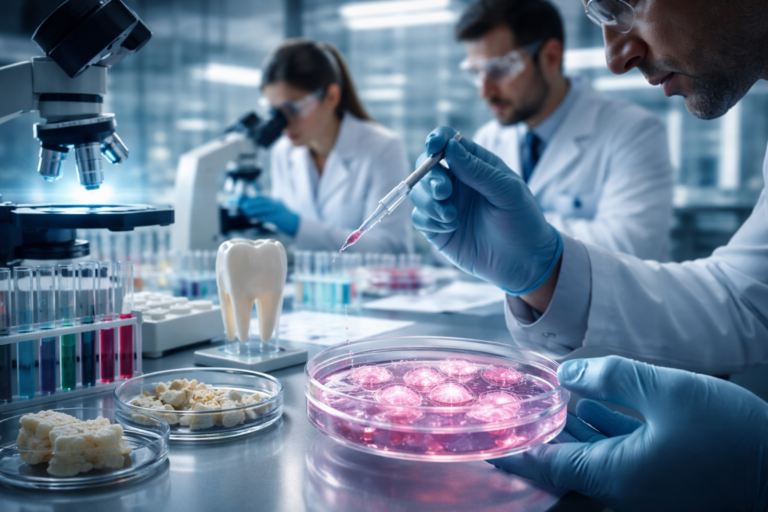
A recent breakthrough in regenerative biology has researchers excited: scientists have identified a population of stem cells with the potential to regenerate human teeth and repair damaged bone. While the work is still early-stage, the discovery opens new avenues for treating tooth loss, craniofacial trauma, and bone defects with living tissue rather than synthetic implants.
What was discovered
Researchers isolated a subset of stem cells from dental tissue and nearby jawbone that show both dental and osteogenic (bone-forming) potential. In laboratory studies and animal models, these cells:
- Differentiate into odontoblast-like cells that produce dentin, the hard tissue beneath tooth enamel.
- Form bone tissue when placed in bone defects.
- Integrate with surrounding tissues and vascularize, supporting long-term survival.
This dual potential—supporting both tooth tissue formation and bone repair—marks a meaningful step beyond earlier stem cell types that were more lineage-restricted.
Why these stem cells matter
Tooth loss and bone injuries are major clinical problems. Current solutions include dental implants, crowns, grafts, and prosthetics, which restore function but have limitations: implants require healthy bone, grafts can resorb over time, and prosthetics don’t fully recreate natural tooth structure or sensation.
Stem-cell-based regeneration could change that by:
- Replacing lost tissue with living, functional tissue.
- Restoring natural tooth anatomy and potentially nerve and vascular components.
- Repairing bone defects in ways that integrate biologically and remodel over time.
The ability to derive both tooth and bone tissue from a common cell source could simplify regenerative therapies for complex craniofacial conditions.
How the approach works
The general strategy being explored involves several components:
- Isolation: Harvesting stem cells from dental pulp, periodontal ligament, or nearby jawbone.
- Expansion: Growing cells in culture while maintaining their regenerative potential.
- Differentiation: Guiding cells toward odontogenic (tooth-forming) or osteogenic (bone-forming) fates using growth factors and scaffolds.
- Delivery: Placing cells into the defect site with a biocompatible scaffold that supports 3D growth and vascularization.
- Integration: Encouraging the regenerated tissue to integrate with surrounding bone and soft tissues.
In animal studies, pre-conditioned cells delivered on porous scaffolds have produced dentin-like and bone-like structures and supported remodeling. Researchers are refining the signals and scaffold materials to optimize maturation, strength, and longevity.
Potential benefits
- Reduced need for synthetic implants or large bone grafts.
- Improved functional and aesthetic outcomes for dental and craniofacial reconstruction.
- Possibility of autologous therapies using a patient’s own cells, lowering immune rejection risk.
- Long-term remodeling and adaptation of regenerated tissues, unlike fixed prosthetics.
Challenges and limitations
Despite excitement, several hurdles remain before clinical use:
- Safety: Ensuring cells do not form unwanted tissues or tumors.
- Predictability: Achieving consistent, reproducible formation of fully functional tooth structures and mechanically robust bone.
- Scale: Generating sufficient cell numbers and tissue volume for human-sized defects.
- Vascularization and innervation: Promoting blood vessel and nerve growth within regenerated tissue for viability and sensation.
- Regulatory and manufacturing pathways: Developing standardized, GMP-compliant protocols for cell therapies.
Translating promising animal data into safe, effective human treatments typically requires years of optimization and clinical trials.
What comes next
Researchers will focus on:
- Refining cell isolation and expansion methods to preserve regenerative potential.
- Optimizing scaffolds and molecular cues to direct tissue formation.
- Long-term animal studies to assess durability, function, and safety.
- Early-phase clinical trials for defined indications such as small dental defects or localized bone repair.
Collaboration among stem cell biologists, materials scientists, clinicians, and regulatory experts will be crucial to move the field forward.
Conclusion
The report that “Researchers identify highly promising stem cells that could one day regenerate human teeth and repair damaged bone” points to an exciting frontier in regenerative medicine. While practical, routine applications remain years away, the discovery lays important groundwork for therapies that might one day restore natural tooth and bone tissue—improving outcomes for millions affected by dental disease, trauma, and congenital defects.