
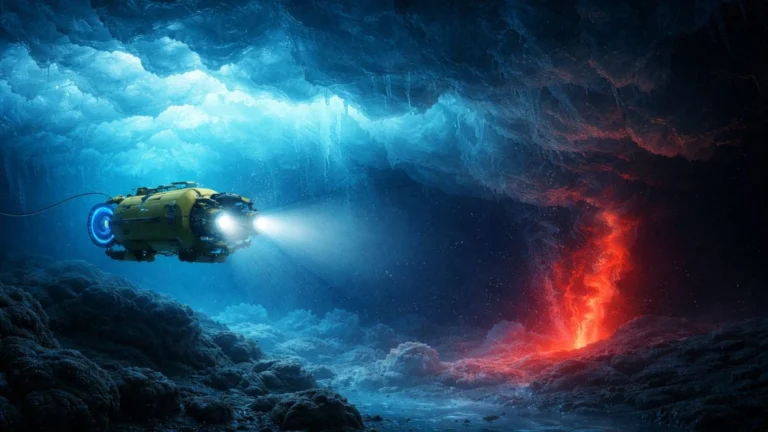
A robot drifting for eight months beneath Antarctica’s massive glaciers has detected a signal scientists have long feared. An autonomous robot that drifted for eight months beneath Antarctica’s massive glaciers has detected a signal scientists have long feared: the intrusion of warm, salty ocean water into cavities beneath the ice. The finding adds weight to growing concerns that parts of the West Antarctic Ice Sheet are becoming increasingly vulnerable to rapid melting and irreversible retreat.
What the robot found
The vehicle mapped temperature, salinity, and currents in the dark space where glacier ice and ocean meet. Over the mission it recorded:
- Warmer-than-expected water temperatures near the glacier base.
- Saline layers and current patterns consistent with upwelling of deep ocean water.
- Signs of enhanced basal melt in the cavity where the ice floats or sits close to the seabed.
Taken together, these measurements point to a process scientists have long warned about: relatively warm circumpolar deep water (CDW) reaching the grounding lines and undersides of marine-terminating glaciers, thinning ice from below and destabilizing the glacier’s connection to the bedrock.
How the robot worked
Operating under Antarctic ice is one of the most hostile environments on Earth. The robot used for this mission was an autonomous underwater vehicle (AUV) designed to:
- Drift with sub-ice currents while periodically profiling the water column.
- Measure temperature, salinity (conductivity), and velocity.
- Send acoustic or satellite updates when in communication range.
Because direct human access to the cavity beneath fast-flowing glaciers is impossible, these robotic explorers provide the only practical way to gather continuous, year-round data in the regions where ocean and ice interact. An eight-month deployment allowed scientists to see seasonal changes and capture rare events that short missions miss.
Why scientists have long feared this signal
The fear centers on feedbacks and thresholds. Key reasons this discovery is worrying:
- Warm water undercuts glaciers. When warm, salty water reaches the grounding line—the point where the ice sheet begins to float—it melts ice from below. This basal melting can cause the grounding line to retreat inland onto deeper slopes, which speeds up ice discharge into the ocean.
- Marine ice-sheet instability. Certain bed geometries (retrograde slopes) can provoke runaway retreat: as the grounding line retreats to deeper water, ice flux increases, promoting further retreat.
- Potential for rapid sea level rise. West Antarctica contains enough ice to raise global sea level by meters if large sectors collapse. While full collapse would take centuries, acceleration in decades is possible and poses risks to coastal communities and infrastructure.
Detecting the ocean forcing directly beneath glaciers confirms a key link in this chain: the ocean is already delivering heat to places that can trigger rapid changes.
Implications for sea level and climate policy
This robotic detection doesn’t mean immediate catastrophe, but it does change the technical and political calculus:
- Improved risk estimates: Direct observations let models better simulate grounding-line response and project sea-level contributions with higher confidence.
- Urgency for monitoring: Continuous robotic observations and repeated surveys are now essential to detect acceleration and inform adaptation planning.
- Global consequences: Even incremental increases in projected sea-level rise affect insurance, infrastructure design, and long-term coastal planning worldwide.
What comes next
Scientists will use the robot’s data to refine ice-ocean models and plan follow-up missions. Key next steps include:
- Expanding robotic deployments to other vulnerable glaciers.
- Combining AUV data with satellite observations of ice velocity and elevation.
- Running high-resolution models that couple ocean, ice, and atmosphere to estimate future behavior.
The discovery underscores a simple truth: beneath the frozen surface, dynamic processes driven by the ocean can shape the future of Earth’s ice sheets. Robotic explorers that endure months in that darkness are now giving researchers the measurements they need to understand—and prepare for—the changes ahead.