
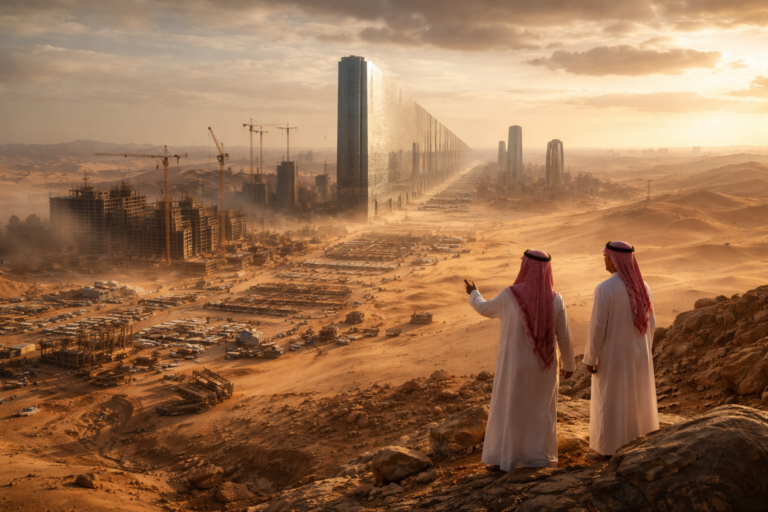
The announcement of Neom and its flagship concept, The Line, felt like a manifesto: a linear, car-free city slicing through the Saudi desert, powered by renewables, home to millions, and a testbed for humanity’s ability to build climate-proof futures in the hottest places on Earth. But grand visions rarely survive unscathed. As climate realities and fiscal constraints press in, the dream is being reshaped. That shift raises a hard question: is this retrenchment a necessary course correction—or a capitulation that abandons one of our boldest experiments in survival?
The collision of ambition and reality
Megaprojects in extreme environments always carry compounded risks. For Saudi Arabia’s desert city proposals, several hard limits are converging.
- Physical climate limits: rising temperatures, extreme heat events, dust storms and evaporation rates all increase the cost and complexity of keeping people comfortable and water supplied.
- Resource intensity: desalination, cooling, and energy storage are not free. They demand huge capital, continuous energy input, and create environmental side effects (brine, ecosystem stress).
- Fiscal and political constraints: even countries with large sovereign wealth may reprioritize when returns are uncertain or global markets shift.
In short, the engineering optimism that birthed the megacity idea met a ledger and a climate model. Recalibration was predictable.
Realism: why scaling back can be sensible
Pulling back on moonshot projects can be a rational, even responsible, choice. Consider the arguments for realism:
- Risk management: Large-scale pilots can fail spectacularly. Smaller, iterative projects allow testing, learning, and course correction with lower downside.
- Cost-effectiveness: Redirecting capital toward distributed renewables, water efficiency, and urban retrofits could yield greater resilience per dollar spent.
- Environmental prudence: Massive coastal development and desalination can exacerbate local ecological harm. Scaling plans allows for better impact assessment and mitigation.
- Social legitimacy: Ambitious plans that sweep aside local communities or fail to secure buy-in risk long-term instability. Slower, participatory approaches can deliver more durable outcomes.
In this view, shrinking the dream is not defeat; it’s an embrace of steady, evidence-driven policy over spectacle.
Surrender: what’s lost if ambition wanes
Yet there’s a countervailing loss when audacity retreats. Some reasons to worry:
- Innovation stagnation: Big, risky projects can catalyze breakthroughs—new materials, cooling strategies, and integrated systems—that smaller pilots might not justify.
- Moral hazard of avoidance: If wealthy states shrink ambitions because climate adaptation is hard, it sets a precedent for inaction elsewhere.
- Opportunity cost: Desert megacities served partly as a symbolic demonstration: that humanity could reimagine habitability. Abandoning that premise dampens global imagination when radical solutions are urgently needed.
So the question isn’t just fiscal prudence, it’s whether we value the potential for high-reward experimentation even when it carries high risk.
Toward a third path: adaptive audacity
The best answer likely sits between these poles. A few guiding principles:
- Break projects into modular phases that can be scaled up only after clear success metrics are met.
- Invest in high-leverage research—materials science, passive cooling, energy storage, low-cost desalination—that benefits other regions as well.
- Prioritize ecological and social safeguards from day one, ensuring local communities have a voice and benefits.
- Use pilot districts as living labs whose technologies and governance models are transferrable to more affordable retrofits elsewhere.
This preserves the spirit of audacity while respecting limits. It reframes the megacity not as a single all-or-nothing gamble, but as a platform for staged innovation.
Final thought
Saudi Arabia’s rethink need not be read as either a triumphant return to sobriety or a short-sighted surrender. It can be a teachable moment: a reminder that survival in a warming world requires both imagination and humility. The challenge now is to keep ambition alive—but smarter, greener, and more accountable—so that the lessons learned in the desert can help humanity adapt, rather than abandon, its most audacious experiments in survival.