
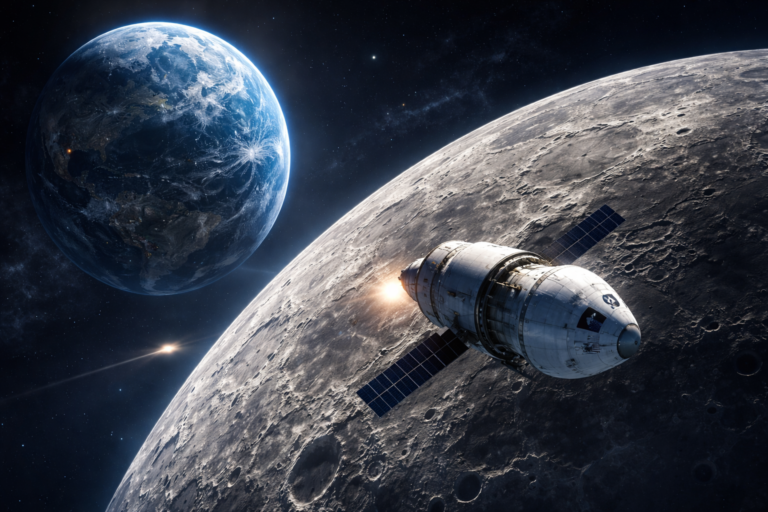
Humanity’s return to the Moon is no longer a distant dream. The Artemis 2 mission marks the first crewed flight in NASA’s Artemis program and will set the stage for sustained lunar exploration. Below is a clear, step-by-step look at how the Artemis 2 mission will unfold and why it matters.
Why Artemis 2 matters
Artemis 2 is the first time astronauts will travel beyond low Earth orbit in the Orion spacecraft since Apollo. This mission is a test of systems, procedures, and human endurance in deep space, bridging decades of lunar absence and enabling future missions that will land humans on the Moon again.
Beyond hardware validation, Artemis 2 will validate operations for deep-space crewed missions, exercise international partnerships, and provide invaluable data for longer stays on the lunar surface and eventual Mars missions.
Mission objectives
- Validate life-support, navigation, and communication systems aboard Orion with a crew.
- Test crewed operations during translunar injection, lunar flyby, and return trajectories.
- Demonstrate ground-to-space communications and mission control procedures for deep-space missions.
- Gather human physiological and psychological data during a multi-day deep-space flight.
Crew and spacecraft
Artemis 2 will carry a small crew aboard the Orion spacecraft, launched by NASA’s Space Launch System (SLS) rocket. Orion is designed for deep-space missions with radiation protection, life support, and a reentry capsule capable of returning astronauts safely to Earth.
The crew will be composed of highly trained astronauts, prepared for manual and automated operations. Their tasks include system checks, navigation monitoring, and science and biomedical experiments designed for the unique deep-space environment.
Launch and trajectory
The mission begins with the SLS rocket lifting Orion from Earth into orbit. Once in a stable parking orbit, the spacecraft will perform a translunar injection burn to leave Earth orbit and head toward the Moon.
Key flight phases:
- Launch and orbit insertion: SLS places Orion into Earth orbit.
- Translunar injection: A burn propels Orion toward the Moon.
- Cruise to the Moon: A multi-day transit with system checks and experiments.
- Lunar flyby: Orion will loop around the Moon without landing.
- Return transit: A return burn sends the spacecraft back to Earth.
- Earth reentry and splashdown: Orion returns through the atmosphere and splashes down for recovery.
The lunar flyby: a critical test
Artemis 2 will not land on the Moon; instead, it will perform a close flyby. This maneuver is crucial because it exposes both crew and spacecraft to deep-space conditions—radiation, thermal extremes, and communications delays—while testing navigation accuracy and crewed operations near the Moon.
During the flyby, the crew will collect observations and perform science and engineering tests, including antenna and telemetry checks to ensure communication links function across long distances. The flyby also provides a unique opportunity for high-resolution imaging and lunar observations that support future landing site selection.
Science and human research
Though brief, the mission will carry biological and physical experiments to understand how humans respond to deep-space travel. Small instruments may monitor radiation exposure, sleep patterns, and cognitive performance, helping teams refine countermeasures for longer missions.
Engineering experiments will validate autonomous systems, power management, and thermal control, offering lessons for Artemis 3 and beyond, when astronauts will actually land on the lunar surface.
Safety, contingency, and recovery
Safety is the top priority. Artemis 2 will have multiple abort modes for ascent and options for corrective maneuvers during transit. Mission control will rehearse contingencies extensively, and recovery forces will be staged to retrieve the crew immediately after splashdown.
The mission’s design emphasizes redundancy: critical systems have backups, and procedures allow the crew to take manual control if necessary.
What comes after Artemis 2
Success on Artemis 2 unlocks the path to Artemis 3, which aims to put astronauts on the lunar surface, including the Moon’s south pole. Subsequent Artemis missions will expand lunar infrastructure, enable sustainable science, and prepare for human missions to Mars.
Artemis 2 is the bridge between the technological groundwork laid by Artemis 1 and the operational lunar landings to come. It will prove that humans can operate safely and effectively beyond low Earth orbit in the modern era.
Conclusion
The Artemis 2 mission is more than a flyby: it’s a decisive step in the great return of humanity to the Moon. By validating crewed operations, testing Orion systems in deep space, and gathering human health data, Artemis 2 will shape the next decade of lunar exploration and beyond. As the countdown progresses, the world watches a new chapter of exploration unfold—one that reconnects us with our nearest celestial neighbor and pushes the boundaries of human presence in space.