
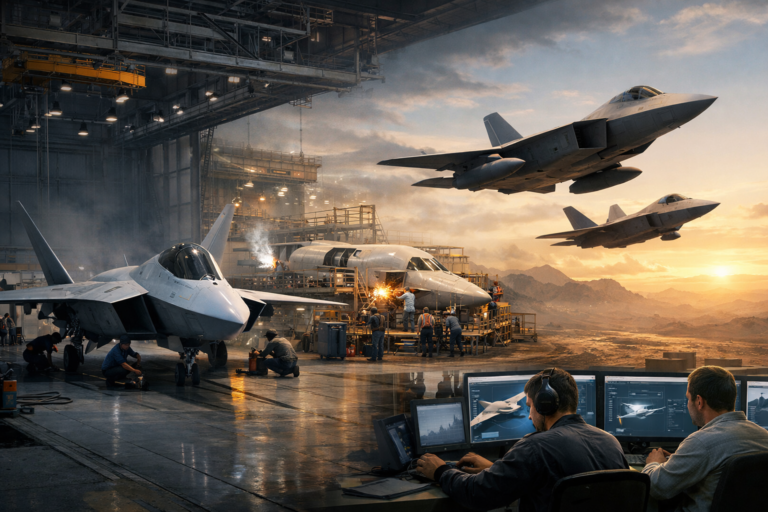
The United States is pushing forward with an ambitious vision: developing two next-generation fighter programs simultaneously—the Air Force’s Next Generation Air Dominance (NGAD) and the Navy’s F/A-XX. These programs aim to define air superiority for decades, introducing sixth-generation fighter technology, including stealth, artificial intelligence, and manned-unmanned teaming.
However, behind this strategic ambition lies a harsh reality. The U.S. defense industrial base is struggling with a severe shortage of skilled labour, making it increasingly difficult to execute both programs at once. This tension between technological ambition and workforce limitations is becoming one of the most critical challenges for America’s military future.
What Are The Two Fighter Programs?
NGAD: The Air Force’s Flagship Program
The NGAD program is designed to replace the F-22 and deliver unmatched air superiority. It includes a sixth-generation fighter (F-47) supported by drone “wingmen” known as Collaborative Combat Aircraft (CCA).
Key highlights:
- Expected procurement: ~200 NGAD fighters
- Supporting drones: 1,000+ CCAs
- First flight target: around 2028
- Operational timeline: 2030s
The aircraft will feature advanced stealth, long-range capabilities, and AI-driven combat systems.
F/A-XX: The Navy’s Next Carrier Fighter
The Navy’s F/A-XX program aims to replace the F/A-18 Super Hornet and complement the F-35C.
Key highlights:
- Multi-role sixth-generation fighter
- Designed for carrier operations
- Competing contractors: Boeing, Northrop Grumman
- Development ongoing since early 2010s
Unlike NGAD, F/A-XX focuses on naval integration, endurance, and survivability in contested maritime environments.
Why The U.S. Wants A Fighter Duo
The U.S. military believes that separate Air Force and Navy platforms are essential due to different mission requirements.
Strategic Benefits
- Tailored capabilities for air vs naval warfare
- Redundancy in critical combat systems
- Enhanced global deterrence
Technological Leap
Sixth-generation fighters are expected to include:
- Stealth beyond current radar detection
- AI-assisted decision-making
- Manned-unmanned teaming
- Long-range hypersonic weapons
The Brutal Equation: Skilled Labour Shortage
While funding and technology dominate headlines, the real bottleneck is workforce capacity.
Key Workforce Challenges
- Aging workforce in aerospace manufacturing
- Shortage of engineers, technicians, and machinists
- Limited pipeline of STEM graduates
- Competition from commercial tech industries
The U.S. already faces a major skilled worker gap, with estimates of hundreds of thousands of additional workers needed in advanced industries.
Impact On Defense Programs
1. Delays And Rescoping
The NGAD program has already faced:
- Budget reassessments
- Program delays and redesign considerations
- Potential cost exceeding $100 billion lifecycle
2. Rising Costs
Limited labour supply leads to:
- Higher wages
- Slower production timelines
- Increased program costs
3. Industrial Base Stress
The defense sector relies on a complex supply chain, including:
- Aerospace engineers
- Precision manufacturing specialists
- Advanced materials experts
Shortages at any level disrupt the entire ecosystem.
Table: Key Facts About US Next-Generation Fighter Programs
| Category | NGAD (Air Force) | F/A-XX (Navy) |
|---|---|---|
| Type | Sixth-generation air superiority fighter | Sixth-generation carrier-based fighter |
| Replacement | F-22 Raptor | F/A-18 Super Hornet |
| Timeline | 2028–2030s | 2030s |
| Expected Units | ~200 fighters | Undisclosed |
| Drone Integration | Yes (1,000+ CCAs) | Likely |
| Key Contractors | Boeing (selected), others | Boeing, Northrop Grumman |
| Estimated Cost | $100B+ lifecycle | Not fully disclosed |
| Major Challenge | Skilled labour shortage | Skilled labour shortage |
Industrial Reality: Can The U.S. Do Both?
The U.S. aerospace and defense market is massive—valued at $463 billion in 2026 and projected to reach $610 billion by 2031.
Despite this scale, capacity is not infinite.
Key Constraints
- Workforce shortages limit production scalability
- Supply chain bottlenecks in critical materials
- Competing priorities (e.g., B-21 bomber, missiles, space systems)
The Core Dilemma
The Pentagon must decide:
- Continue both programs at full speed
- Prioritize one over the other
- Delay timelines to match workforce availability
Future Outlook: Adaptation Or Compromise?
1. Increased Automation
AI and robotics may reduce dependence on human labour.
2. Workforce Development
Government initiatives aim to:
- Expand STEM education
- Attract foreign talent
- Upskill existing workers
3. Shift Toward Drones
The rise of unmanned systems (CCA) may reduce reliance on expensive manned fighters.
Conclusion
The United States stands at a crossroads in military aviation. While the ambition to build two next-generation fighter programs reflects unmatched technological leadership, the shortage of skilled labour presents a serious structural challenge.
Without significant investment in workforce development and industrial capacity, the dream of a dual sixth-generation fighter fleet may face delays, redesigns, or strategic compromises. The future of U.S. air dominance will depend not just on innovation—but on people, skills, and industrial resilience.