
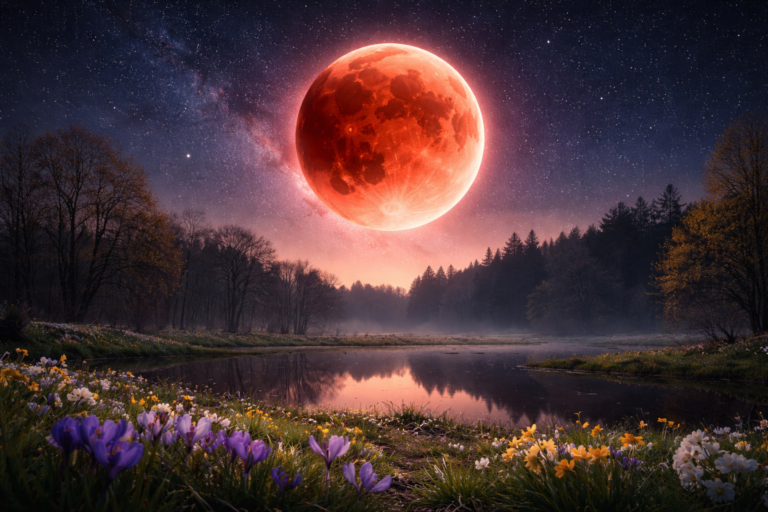
The Worm Moon 2026 is not just another full moon—it is a rare astronomical spectacle combining a full moon and a total lunar eclipse, often called a “Blood Moon.” Occurring at the very start of meteorological spring, this celestial event offers skywatchers a breathtaking opportunity to witness science, tradition, and seasonal change align in one night.
In 2026, this event stands out even more because it is the only total lunar eclipse of the year and the last one visible globally until late 2028.
What Is The Worm Moon?
The Worm Moon is the traditional name for the March full moon. The name originates from early Native American and colonial traditions, marking the time when earthworms reappear as the ground begins to thaw, signaling the end of winter.
This full moon symbolizes:
- The transition from winter to spring
- Renewal of wildlife activity
- Longer daylight hours
Other historical names include:
- Sap Moon
- Crow Moon
- Crust Moon
Key Facts About The Worm Moon 2026
| Event Detail | Information |
|---|---|
| Date | March 3, 2026 |
| Full Moon Peak | 6:38 AM ET (11:38 UTC) |
| Eclipse Type | Total Lunar Eclipse |
| Totality Duration | ~58 minutes |
| Visibility Regions | North America, Asia, Australia, Pacific |
| Special Feature | Blood Moon (reddish color) |
| Next Total Lunar Eclipse | December 31, 2028 |
This full moon will appear full for about three nights (March 2–4), but the eclipse occurs specifically during its peak phase.
The Total Lunar Eclipse: A Rare Blood Moon Event
On March 3, 2026, the Moon will pass completely into Earth’s shadow, creating a total lunar eclipse. During this phase, the Moon turns a deep copper-red color, earning the nickname “Blood Moon.”
Why Does The Moon Turn Red?
The red color occurs because:
- Earth’s atmosphere filters sunlight
- Blue light scatters away
- Red and orange wavelengths bend toward the Moon
This creates the illusion that all Earth’s sunrises and sunsets are projected onto the Moon at once.
Eclipse Timeline (Approximate)
- Penumbral Phase Begins: Around 3:44 AM ET
- Partial Eclipse Begins: Around 4:50 AM ET
- Total Eclipse (Totality): 6:04 AM – 7:02 AM ET
- Maximum Eclipse: ~6:33 AM ET
- Ends: Around 9:22 AM ET
The entire event lasts over five hours, though the most dramatic phase (totality) lasts just under an hour.
Where Will The Worm Moon Eclipse Be Visible?
The 2026 eclipse will be visible across multiple continents:
Best Viewing Regions
- North America (especially western regions)
- Australia & New Zealand
- East Asia & Pacific regions
Viewing Conditions
- Western North America: Best pre-dawn visibility
- Asia & Australia: Evening viewing
This wide visibility means billions of people will have a chance to witness the event.
Why This Event Is So Special
The Worm Moon 2026 is extraordinary for several reasons:
- It is the only total lunar eclipse of 2026
- It marks the final total eclipse before a nearly 3-year gap
- Totality lasts approximately 58 minutes, making it a long and vivid event
- It coincides with the seasonal transition into spring
Astronomically, such alignments require precise positioning of the Sun, Earth, and Moon, making them relatively rare.
Connection To Meteorological Spring
Meteorological spring begins on March 1 in the Northern Hemisphere. The Worm Moon follows immediately after, reinforcing its symbolic meaning:
- Renewal and growth
- Awakening of ecosystems
- Beginning of agricultural cycles
This makes the 2026 Worm Moon both a scientific event and a seasonal milestone.
Best Tips To Watch The Worm Moon 2026
To fully enjoy this celestial event:
Viewing Tips
- Choose a dark location away from city lights
- Start watching before totality begins
- Use binoculars or a telescope for detail
- Check weather conditions in advance
Unlike solar eclipses, lunar eclipses are completely safe to view with the naked eye.
Scientific Significance
Lunar eclipses provide valuable insights into:
- Earth’s atmospheric composition
- Orbital mechanics
- Light scattering and refraction
They also help astronomers study how dust and particles in Earth’s atmosphere affect light filtering, influencing the Moon’s color.
Future Outlook
After the 2026 event:
- No total lunar eclipse will occur until December 31, 2028
- A partial lunar eclipse will occur in August 2026
- A new cycle of eclipses resumes in 2029
This makes the 2026 Worm Moon a must-watch event for sky enthusiasts.
FAQs
1. What Is The Worm Moon 2026?
The Worm Moon is the March full moon, and in 2026 it coincides with a total lunar eclipse, creating a rare Blood Moon.
2. When Can I See The Worm Moon Eclipse?
The peak occurs on March 3, 2026, with totality lasting about 58 minutes in the early morning or evening depending on location.
3. Is It Safe To Watch A Lunar Eclipse?
Yes, a lunar eclipse is completely safe to view with the naked eye, unlike solar eclipses.
The Worm Moon 2026 is a remarkable blend of astronomy, tradition, and seasonal change. With its rare total lunar eclipse, long duration, and global visibility, it stands as one of the most significant sky events of the decade.
As the Moon turns a deep red and signals the arrival of spring, this event reminds us of the beauty and precision of the universe. Missing it would mean waiting nearly three years for another similar spectacle.