
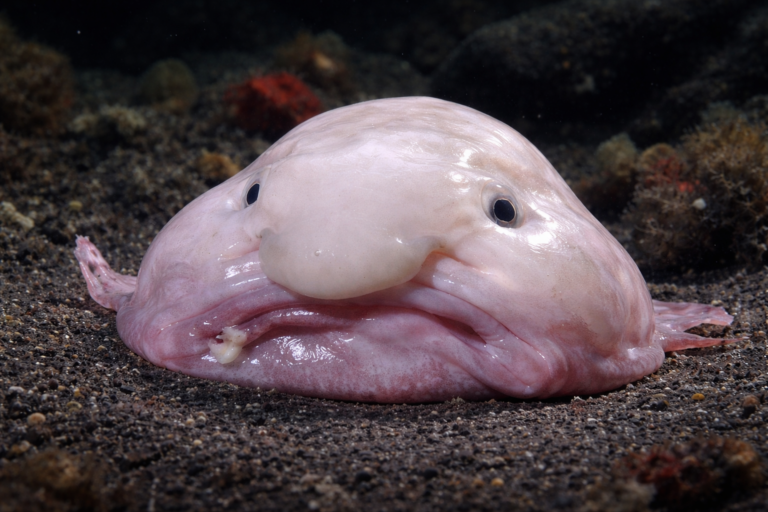
The blobfish—often labeled the “world’s ugliest animal”—is one of the most misunderstood creatures on Earth. Known scientifically as Psychrolutes marcidus, this deep-sea fish became globally famous for its unusual appearance. However, behind its viral image lies a fascinating story of deep-sea adaptation, rediscovery, and conservation concern.
Although it gained worldwide recognition in recent decades, this species was largely unknown to the public until the late 20th century, with sightings becoming more common due to deep-sea exploration and fishing. Today, it symbolizes a broader issue: how less “attractive” species are often overlooked in conservation efforts.
What Is The Blobfish?
The blobfish is a deep-sea fish found in waters off Australia, Tasmania, and New Zealand. It lives at depths of 600 to 1,200 meters, where pressure is dozens of times higher than at sea level.
Key Characteristics
- Scientific Name: Psychrolutes marcidus
- Habitat Depth: 600–1,200 meters
- Weight: Around 2–4 kg
- Lifespan: Estimated up to 100+ years
- Diet: Small crustaceans and organic matter
Unlike typical fish, the blobfish has no swim bladder, minimal muscle, and a gelatinous body, allowing it to float effortlessly in extreme pressure environments .
Why Is It Called The “World’s Ugliest Animal”?
The blobfish earned its infamous title in 2013, when it was voted the “world’s ugliest animal” in a campaign by the Ugly Animal Preservation Society .
The campaign aimed to highlight species that are often ignored because they lack visual appeal. Over 3,000 votes were cast, and the blobfish became the official mascot for “unattractive” endangered animals .
The Truth About Its Appearance
The famous “ugly” look is misleading.
- Underwater: Looks like a normal fish
- On surface: Becomes gelatinous and droopy due to decompression
This distortion happens because pressure changes damage its body structure, creating the iconic saggy face .
Rediscovery And Rise To Fame
While not truly extinct, the blobfish remained rarely seen for decades due to its deep-sea habitat. It gained attention after a 2003 photograph taken during a research expedition went viral, sparking global curiosity .
This moment marked its “rediscovery” in public consciousness, transforming it into a symbol of deep-sea biodiversity.
Conservation Status And Threats
The blobfish is considered vulnerable, although exact population numbers remain uncertain due to limited research.
Major Threats
- Deep-sea trawling: Primary danger, as blobfish are often caught accidentally
- Habitat destruction: Ocean floor ecosystems are fragile
- Slow reproduction: Makes recovery difficult
Deep-sea fishing practices, especially targeting species like orange roughy, frequently bring blobfish to the surface, where they cannot survive .
Blobfish Data Table
| Feature | Details |
|---|---|
| Scientific Name | Psychrolutes marcidus |
| Habitat | Deep ocean (Australia, New Zealand) |
| Depth Range | 600–1,200 meters |
| Conservation Status | Vulnerable (estimated) |
| Lifespan | Up to 100–130 years |
| Main Threat | Deep-sea trawling |
| Famous Year | 2013 (Ugliest Animal title) |
| Unique Trait | Gelatinous body for pressure survival |
Unique Adaptations Of The Blobfish
1. Pressure-Resistant Body
Its gelatinous tissue is slightly less dense than water, allowing it to float without expending energy.
2. No Swim Bladder
Unlike most fish, it doesn’t need a swim bladder, which would collapse under extreme pressure.
3. Energy Efficiency
Blobfish are ambush feeders, consuming whatever drifts near them—an adaptation to food scarcity.
4. Parental Care
Females can lay up to 100,000 eggs and guard them, showing rare parental behavior in deep-sea fish .
Why “Ugly” Animals Need More Protection
Conservation efforts often focus on charismatic animals like pandas and tigers, leaving species like the blobfish overlooked.
The Ugly Animal Preservation Society was created to change this narrative, emphasizing that every species plays a vital ecological role .
Key Insight
- “Cute” animals receive more funding
- “Ugly” species face equal or greater threats
- Awareness campaigns can shift public perception
Recent Developments And Growing Interest
In 2025, the blobfish gained renewed attention after being named “Fish of the Year” in New Zealand, highlighting rising public interest in marine conservation .
This shift shows that public perception is changing, and even the most unusual species can become conservation icons.
Future Outlook
The future of the blobfish depends on deep-sea conservation policies and increased scientific research.
What Needs To Be Done
- Regulate deep-sea trawling
- Increase marine biodiversity studies
- Promote awareness of lesser-known species
- Protect fragile deep-ocean ecosystems
If these steps are taken, the blobfish could transition from a symbol of neglect to a success story in conservation.
Conclusion
The blobfish’s journey from obscurity to being labeled the “world’s ugliest animal” reflects more about human perception than the creature itself. Far from being a biological oddity, it is a perfectly adapted deep-sea survivor facing real threats from human activity.
Its story is a powerful reminder that every species—beautiful or not—deserves attention, research, and protection. As awareness grows, the blobfish may yet become a symbol of how conservation can evolve beyond appearances.