
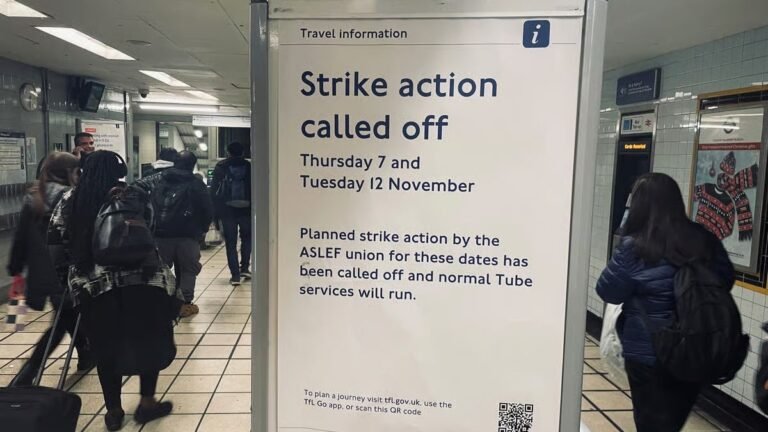
Transport officials and union representatives are meeting in an effort to prevent a wave of London Underground strikes that could disrupt services for several weeks.
Negotiations scheduled for Monday aim to avoid widespread travel problems for passengers as tensions grow between Transport for London (TfL) and the RMT union over proposed working changes for Tube drivers.
London’s transport commissioner Andy Lord has stated that while disruption may occur if the strikes proceed, it is unlikely to be as severe as initially feared. At the same time, he criticized the union’s decision to call industrial action, describing it as unnecessary at this stage.
Negotiations Begin To Avoid Major Tube Strike Disruption
Efforts to prevent the planned strikes are taking place at TfL’s Palestra headquarters, where union negotiators have been invited to discuss concerns regarding a proposed voluntary four-day working week for Tube drivers.
The meetings are intended to reassure the Rail, Maritime and Transport (RMT) union that the plan will remain optional rather than mandatory.
The union has expressed concerns that if the changes are eventually enforced, drivers could experience greater fatigue and reduced work-life balance. As a result, the RMT announced strike action beginning later in March.
Planned Strike Schedule Could Affect London Underground Services
The RMT has outlined a series of six 24-hour strikes, each beginning at midday. By starting at noon, the union aims to extend disruption across two separate days.
The schedule includes:
- Two strike days each week
- Industrial action planned during March, April, and May
- Each walkout potentially affecting services across multiple days
The first strike is scheduled to begin at midday on March 24, followed by another walkout on March 26.
Transport officials anticipate severe disruption during the strike periods, particularly from Tuesday midday and Thursday midday onward. Additional service issues could occur during Wednesday and Friday morning commutes.
However, TfL expects disruption outside these periods to be less significant, with services gradually returning to normal by Friday evening.
TfL Says Impact Will Be Less Severe Than Previous Strike
Andy Lord indicated that even if the industrial action proceeds, the scale of disruption will likely be smaller than the strike experienced in September last year.
During that previous dispute, a five-day RMT strike led to a near shutdown of the Underground network for much of the period.
According to Lord, the upcoming strikes should allow service to continue on most lines, although the final timetable and service levels will be confirmed closer to the dates.
He emphasized that TfL expects to keep a majority of the network operating, which would reduce the overall impact on commuters.
Strike Participation Limited To Tube Drivers
One important factor limiting the potential disruption is the number of workers eligible to participate.
The strike involves only RMT train driver members, representing roughly 1,800 employees.
This is significantly fewer than the union’s total London Underground membership of approximately 10,400 workers.
Additionally, strike picket lines are expected to be located at train depots rather than Underground stations, which may further reduce operational disruption.
Drivers belonging to the Aslef union, which represents many Tube drivers, have reportedly been instructed to attend work during the RMT strike days. This could allow more services to run than originally expected.
The Proposed Four-Day Week For Tube Drivers
The central issue behind the dispute is TfL’s proposal to trial a four-day working week for Tube drivers.
Under the proposal:
- Drivers would work the same total hours
- Those hours would be spread across four days instead of five
- Drivers would receive the same salary
TfL plans to initially pilot the scheme on the Bakerloo line, although the trial has not yet begun.
Interestingly, the idea of testing a four-day week originally emerged during earlier negotiations with unions as part of a deal that helped resolve a previous strike.
TfL Insists The Four-Day Week Will Be Voluntary
Transport commissioner Andy Lord stressed that the plan is designed to be voluntary and that no driver will be forced to adopt the new schedule.
Drivers who wish to participate in the trial could switch to the four-day format, while those who prefer the traditional five-day schedule can continue working as they currently do.
Lord argued that the proposal could provide multiple benefits, including:
- Improved work-life balance
- Increased operational efficiency
- Greater flexibility for drivers
He also expressed hope that the union would reconsider the strike action after further discussions.
TfL Urges Union To Reconsider Industrial Action
Lord stated that TfL remains open to continued dialogue and hopes the negotiations will lead to a positive outcome.
He emphasized that strikes rarely benefit either side and suggested the union’s decision to announce industrial action may have come too soon.
Transport authorities are urging the RMT to pause or cancel the planned strikes while talks continue.
Further meetings could take place if both sides believe progress is being made toward resolving the dispute.
Negotiations between Transport for London and the RMT union represent a critical effort to prevent weeks of disruption on the London Underground network. While the union has announced multiple strike dates beginning in late March, TfL believes the impact may be less severe than previous disputes due to limited participation and operational planning.
At the heart of the disagreement is a proposed voluntary four-day workweek for Tube drivers, which TfL argues could improve work-life balance without changing pay or total working hours. As discussions continue, both sides face increasing pressure to reach a compromise that protects services for millions of passengers who rely on the Underground every day.