
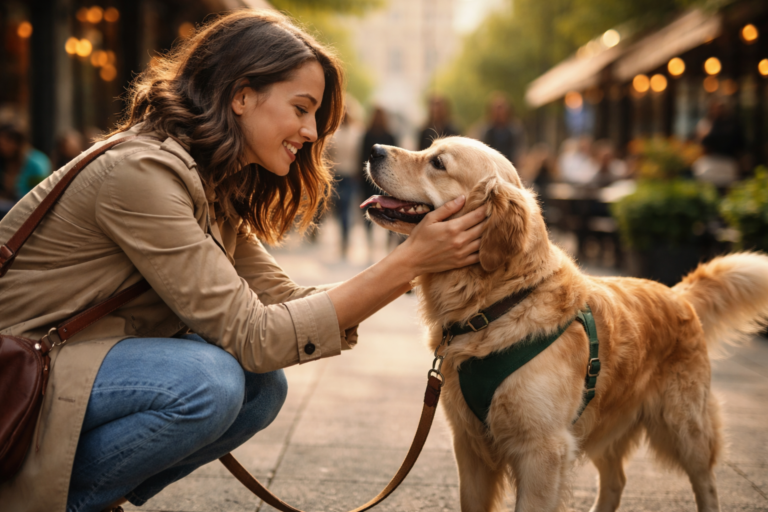
According to psychologists, the simple act of greeting unfamiliar dogs in the street is linked to surprising and specific personality traits that reveal more about you than you think. That small decision — to approach, smile, and crouch down for a sniff — can reflect stable patterns of behavior and the way you relate to other people.
The psychology behind a casual hello
Greeting unfamiliar dogs in the street is often spontaneous, low-stakes, and emotionally rewarding. Psychologists use these everyday moments to observe how people balance curiosity, empathy, risk, and social norms. Because dogs are social beings who respond to human signals, they act as a live test of a person’s interpersonal style.
When you step forward to say hi, you’re doing more than petting an animal. You’re signaling how comfortable you are with uncertainty, how much you prioritize connection, and how sensitively you read nonverbal cues. Researchers and clinicians note that these micro-behaviors map onto larger personality dimensions.
What different behaviors tend to reveal
Below are common greeting patterns and the personality traits they tend to align with:
Approaching eagerly and initiating contact
- Often linked to extraversion: outgoing, sociable, and energized by interaction.
- Reflects high social reward sensitivity and comfort with strangers.
Pausing, observing, then approaching cautiously
- Suggests conscientiousness and thoughtfulness.
- You weigh safety, read body language, and prefer predictable interactions.
Asking the owner for permission and following instructions
- Indicates agreeableness and respect for rules.
- Shows empathy for both animal and owner and a cooperative style.
Avoiding greeting or keeping distance
- May correlate with introversion or social anxiety.
- Could also reflect high neuroticism or a cautious disposition toward unfamiliar situations.
Engaging in playful, creative approaches (singing, funny voices)
- Ties to openness to experience: imaginative, spontaneous, and comfortable with novelty.
Ignoring the dog even when invited to interact
- Might point to low social curiosity, high task-focus, or preoccupation with other concerns.
Why dogs are revealing social mirrors
Dogs respond quickly to tone, posture, and intention. That responsiveness amplifies your own signals, making your behavior more visible. A person who smiles and leans in gets tail wags and friendly approaches — a positive feedback loop that reinforces sociable behavior. Conversely, someone stiff or closed-off gets guarded responses, which reinforces caution.
Dogs also occupy an ambiguous social role: they are not humans, but they are companions for many. How we treat nonthreatening others—animals, service workers, strangers—often generalizes to how we treat people. So these pet encounters can be a window into empathy, impulsivity, and moral attention.
Quick self-check: what do you reveal?
Ask yourself these simple questions the next time you encounter an unfamiliar dog:
- Do I move toward the dog or stay back?
- Do I ask the owner first, or assume it’s okay?
- Am I more excited by the dog or more cautious?
- Do I notice the dog’s body language and respond to it?
Your answers will point to patterns — for example, whether you prioritize connection over caution, or whether you are guided by rules and consideration.
How to greet dogs thoughtfully (and safely)
If you want your behavior to reflect the best parts of your personality, follow these practical tips:
- Always ask the owner for permission before approaching.
- Let the dog come to you; extend a closed hand for sniffing.
- Avoid sudden movements, loud noises, or looming over the dog.
- Watch for stress signals: lip licking, yawning, stiff tail, or backing away.
- Respect owners’ boundaries — not every dog wants interaction, however friendly they look.
A small act with big meaning
Greeting unfamiliar dogs in the street is more than a momentary pleasure. It’s an unassuming test of who we are — how brave, kind, cautious, and curious. Next time you pause on the sidewalk, notice your impulse. That little decision can reveal more about your personality than you might expect, and it’s an easy way to practice the qualities you value.