
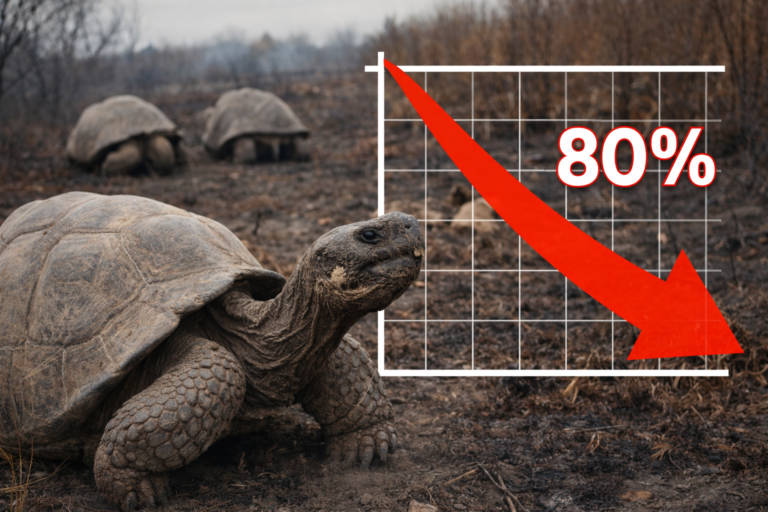
A major ecological warning has emerged from Spain’s iconic Doñana wetlands. Experts report that Galápagos turtles in Doñana have lost nearly 80% of their population in just three decades, raising serious concerns about biodiversity collapse.
Once thriving in the rich marshlands, these ancient reptiles are now on the brink of disappearing locally. Scientists warn that without urgent intervention, this decline could become irreversible.
Population Collapse: The Alarming Numbers
The decline is not gradual—it is dramatic and measurable. Long-term monitoring shows a steep drop in population over time.
Population Data Overview
| Year/Period | Estimated Population | Change |
|---|---|---|
| Early 1990s | 1,200 – 1,500 | Baseline |
| 2022–2026 | 250 – 300 | -80% decline |
Over 30 years, the population has fallen from over 1,200 individuals to around 250–300, meaning fewer than one in five turtles remain.
This dramatic collapse highlights a long-term environmental crisis rather than a sudden event.
Why Are Galápagos Turtles Declining In Doñana?
The decline is driven by multiple interconnected environmental pressures. Experts emphasize that no single cause is responsible.
1. Habitat Degradation
The wetlands of Doñana have undergone significant ecological changes:
- Drying lagoons
- Reduced water availability
- Loss of vegetation
These changes disrupt feeding, nesting, and survival conditions for turtles.
2. Water Scarcity And Hydrological Changes
Altered water systems are a major concern:
- Overuse of groundwater
- Reduced hydroperiod (shorter water presence)
- Increasing salinity levels
These factors make habitats unsuitable for long-term survival.
3. Climate Change Impacts
Rising temperatures and irregular rainfall patterns:
- Accelerate wetland drying
- Reduce breeding success
- Increase mortality rates
4. Human Activities
Human pressure has intensified over the years:
- Agriculture expansion
- Tourism-related water extraction
- Land-use changes
These activities directly degrade natural habitats.
5. Low Reproductive Success
Even surviving populations struggle to recover:
- Fewer hatchlings survive
- Nesting conditions are poor
- Predation and environmental stress increase mortality
Ecological Importance Of Galápagos Turtles
These turtles are not just another species—they are keystone species.
Key Ecological Roles
- Maintain plant diversity through grazing
- Help seed dispersal across wetlands
- Support balanced aquatic ecosystems
Their disappearance could trigger chain reactions, affecting birds, amphibians, and plant life.
A Broader Conservation Context
Globally, Galápagos tortoises have faced historical declines due to:
- Overexploitation
- Habitat destruction
- Invasive species
Populations once numbering over 250,000 dropped to around 15,000 by the 1970s.
Although conservation efforts have helped recovery in native regions, the Doñana case shows that new habitats are increasingly vulnerable.
Current Conservation Efforts
Experts and policymakers are now focusing on urgent recovery strategies.
Key Actions Being Implemented
- Habitat restoration: Rebuilding wetlands and lagoons
- Water management reforms: Reducing groundwater overuse
- Captive breeding programs: Increasing population numbers
- Monitoring systems: Tracking population and ecosystem health
Despite these efforts, success depends on long-term commitment and policy enforcement.
Future Outlook: Can The Species Recover?
The future remains uncertain but not hopeless.
Positive Signs
- Growing global awareness
- Increased scientific monitoring
- Policy-level discussions
Major Challenges
- Climate instability
- Continued human pressure
- Slow reproduction rate
Experts warn that the remaining 20% population is critical—it represents the last chance for recovery.
Key Facts At A Glance
- 80% population decline in 30 years
- From 1,200+ to ~250 individuals
- Driven by habitat loss, climate change, and human activity
- Species plays a vital ecological role
- Recovery requires urgent, coordinated action
Conclusion
The decline of Galápagos turtles in Doñana is a powerful reminder of how fragile ecosystems can be. What once appeared as a stable population has now reached a critical tipping point. The combination of climate change, habitat degradation, and human impact has pushed these ancient reptiles toward local extinction.
However, there is still a narrow window for recovery. With strong conservation policies, sustainable water management, and global awareness, it is possible to stabilize and rebuild the population. The next decade will be decisive—not only for these turtles but for the entire Doñana ecosystem.
A major ecological warning has emerged from Spain’s iconic Doñana wetlands. Experts report that Galápagos turtles in Doñana have lost nearly 80% of their population in just three decades, raising serious concerns about biodiversity collapse. Once thriving in the rich marshlands, these ancient reptiles are now on the brink of disappearing locally. Scientists warn that without urgent intervention, this decline could become irreversible.